

Authorized personnel records
Roster & Archives
Every name has a history.
Every file has a story.
24 ACTIVE EMPLOYEES 40 CASE FILES
No matching records. Try another name or clear the filters.
Active Employees
24 Series 1 Hires. Personnel files, qualifications, and the history behind the staff.
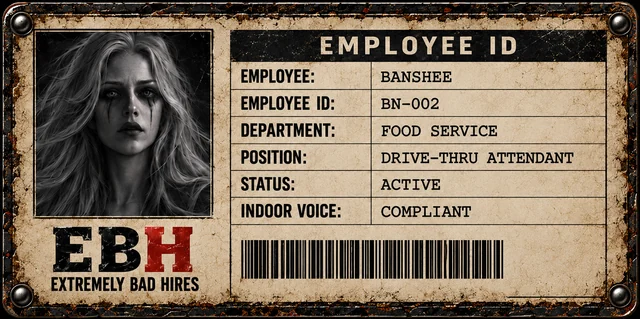 Employee ID / BN-002
Banshee
Drive-Thru Attendant
View dossierClose dossier
Banshee
Drive-Thru Attendant
View dossierClose dossier01 / Background record
History / Lore / What Is It?
The banshee is among the best-known supernatural figures in Irish folklore. Her name comes from the Irish bean sí, with older spellings including bean sídhe, and is often translated as “fairy woman” or “woman of the fairy mound.” In traditional accounts, she is a supernatural messenger associated with death and with particular families. Her presence is most often recognized by sound: a sorrowful cry, wail, or keen resembling the vocal lament once performed at Irish wakes and funerals. Hearing the banshee was believed to warn that a death had occurred or was near, sometimes before news could travel home from far away. Irish folklore does not give her one fixed appearance; accounts describe an old or young woman, loose or flowing hair, white or grey clothing or a cloak, and in some traditions a comb. The central point is that the banshee is generally a herald or mourner of death, not its cause. The familiar horror image of a screaming creature that attacks or kills people is largely a later fantasy interpretation of an older Irish death-warning tradition.
02 / EBH Staffing
EBH Staffing Profile
Banshee was assigned to Food Service after EBH Staffing discovered that years of announcing terrible news had given her exceptional projection, near-perfect order accuracy, and absolutely no fear of an angry customer at 1:17 in the morning. Management reports that she has adapted surprisingly well to the drive-thru headset, although employees are instructed not to investigate when she suddenly stops taking orders, removes one side of the headset, and begins quietly keening toward a specific vehicle in the parking lot. Her personnel file insists that Indoor Voice: Compliant, a rating HR considers technically accurate because nobody ever established what an indoor voice should sound like when it can be heard three counties away. Customer complaints have declined since staff stopped asking why she occasionally adds, “You may want to call your mother,” before reading back an order. EBH Legal would also like the record to show that she does not cause the death. She just has better information than the hospital.
03 / Card appearances
In the deck
- Banshee — Series 1 Hire
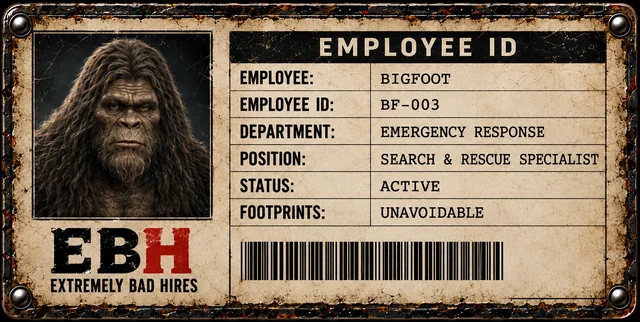 Employee ID / BF-003
Bigfoot
Search & Rescue Specialist
View dossierClose dossier
Bigfoot
Search & Rescue Specialist
View dossierClose dossier01 / Background record
History / Lore / What Is It?
Bigfoot is the name most commonly used in the United States for a large, humanlike creature reported in forests and remote wilderness, especially in the Pacific Northwest. Descriptions often mention an upright gait, a heavy build covered in dark or reddish hair, and unusually large footprints. The modern Bigfoot legend should be distinguished from the many distinct Indigenous traditions about wild or supernatural beings found across North America. Those traditions are not interchangeable, and some carry cultural or spiritual meanings that are very different from modern cryptid hunting. Among the Sts’ailes people of British Columbia, Sa:sq’ets is an important part of cultural identity and spiritual belief and is described as a primary caretaker who watches over the land; the English word Sasquatch comes from an anglicized form of Sa:sq’ets. The name Bigfoot entered widespread American awareness in 1958 after road workers near Bluff Creek in northern California reported enormous humanlike tracks. Bulldozer operator Jerry Crew made a plaster cast of one of the prints and brought it to the Humboldt Times, whose coverage helped popularize the name nationally. Sightings, tracks, recordings, photographs, and films have kept Bigfoot among the world’s best-known unexplained creatures, but no specimen accepted by science has established Bigfoot as a recognized animal species.
02 / EBH Staffing
EBH Staffing Profile
Bigfoot was transferred to Emergency Response after EBH Staffing discovered that losing someone in several hundred square miles of wilderness does not count as “missing” when your employee can smell where they ate breakfast. His Search & Rescue record is exceptional: lost hikers are routinely located before dispatch finishes explaining where they were last seen, although Bigfoot refuses to explain his methods and has submitted “woods” as the answer on three separate incident reports. Supervisors have stopped requiring him to remain on marked trails after learning that he considers trails a suggestion made by people who cannot walk through underbrush properly. His personnel file lists Footprints: Unavoidable, mostly because every supposedly discreet search operation ends with a line of enormous tracks leading directly through the command area, across somebody’s evidence markers, and occasionally over the hood of the rescue coordinator’s truck. The only recurring performance problem is that Bigfoot is considerably better at finding missing people than management is at finding him when mandatory training begins. His response to the latest complaint remains the department’s unofficial policy: “If you were easy to find, they would’ve sent a human.”
03 / Card appearances
In the deck
- Bigfoot — Series 1 Hire
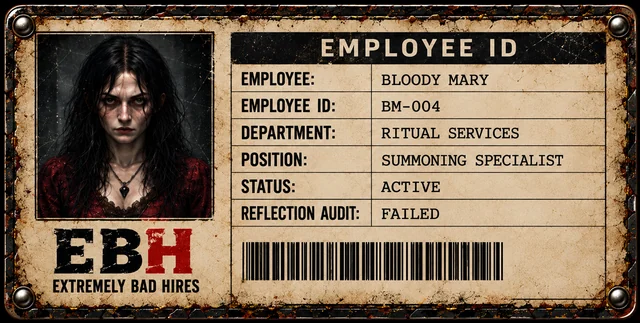 Employee ID / BM-004
Bloody Mary
Summoning Specialist
View dossierClose dossier
Bloody Mary
Summoning Specialist
View dossierClose dossier01 / Background record
History / Lore / What Is It?
Bloody Mary is a modern mirror legend most often circulated among children and teenagers as a supernatural dare. In a common form of the ritual, participants enter a dark bathroom or other dim room, face a mirror, and repeat a name such as Bloody Mary or Mary Worth until an apparition is expected to appear. The details vary widely from one telling to another: the number of repetitions changes, the summoned figure may be described as a ghost, witch, dead girl, or simply a frightening face, and the encounter may end with nothing more than a scare or with warnings of scratching, attack, or death. Folklore collections show that there is no single agreed-upon historical woman behind the legend, and several names and backstories have circulated alongside the same basic mirror ritual. The tradition was being documented in American folklore collections by the 1970s, although oral versions may have circulated earlier. Older mirror-divination customs also existed in Britain and North America, including Halloween practices in which a person looked into a mirror hoping to glimpse a future spouse. Those older customs are useful comparisons, but they do not establish a proven direct origin for Bloody Mary. The modern ritual endures because it combines a ghost story, a dare, and a test of nerve with the unsettling experience of staring into a mirror and waiting for something else to look back.
02 / EBH Staffing
EBH Staffing Profile
Bloody Mary was hired by Ritual Services after EBH Staffing discovered that half the department’s scheduling delays were caused by employees attempting to summon entities that were already on payroll. As Summoning Specialist, Bloody Mary handles mirror-based appointments, invocation scheduling, and what she calls “walk-ins,” which everyone else calls accidentally saying her name near a reflective surface. Her latest Reflection Audit is marked FAILED, not because she failed to appear, but because Compliance still cannot determine whether an employee standing in front of a mirror counts as one person, two images, or an unauthorized portal. She has repeatedly asked Facilities to stop covering bathroom mirrors during maintenance because it creates “unnecessary rescheduling,” and HR has reminded staff that chanting her name as a joke still counts as a valid service request and may be billed to their department. Current office policy is simple: if Bloody Mary appears behind you in the glass, do not turn around, do not ask how she got there, and definitely do not claim you forgot the meeting. The mirror is the appointment. You are the reminder.
03 / Card appearances
In the deck
- Bloody Mary — Series 1 Hire
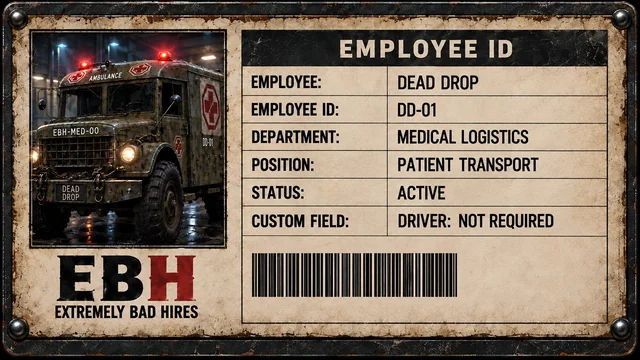 Employee ID / DD-01
Dead Drop
Patient Transport
View dossierClose dossier
Dead Drop
Patient Transport
View dossierClose dossier01 / Background record
History / Lore / What Is It?
Dead Drop is a military ambulance dating from the Vietnam era whose service history becomes less reliable the farther back anyone tries to trace it. The oldest surviving references describe a battered medical transport that should have been decommissioned, stripped for parts, or scrapped decades ago, yet the same vehicle continued turning up at accident scenes, field hospitals, disaster sites, and isolated roads long after it had disappeared from any official motor pool. Witnesses report hearing the engine before the ambulance is visible, seeing its headlights switch on by themselves, and watching the rear doors unlock when someone nearby needs transport. No confirmed driver has ever been identified, and records disagree on where the vehicle was stationed, who maintained it, or even when it left military service. The most persistent part of the Dead Drop story is the passenger count. Transport manifests repeatedly list one more occupant than responders remember loading, and some surviving forms name destinations that had already closed—or cannot be found on any map. The vehicle eventually acquired the name Dead Drop, both for its habit of delivering patients with nobody behind the wheel and for the unanswered question of who, exactly, keeps adding names to the manifest.
02 / EBH Staffing
EBH Staffing Profile
Dead Drop joined Medical Logistics after three departments spent six months arguing over whether it should be classified as a vehicle, equipment, or an employee. HR ended the dispute by issuing it an Employee ID and has regretted setting that precedent ever since. As Patient Transport, Dead Drop requires no driver, never calls in sick, and has an unnerving habit of arriving in the ambulance bay several minutes before Dispatch receives the transport request. The rear doors open on their own, the gurney locks engage without assistance, and the radio occasionally answers questions nobody remembers asking. Its file lists Driver: Not Required, which Compliance insists is correct even though nobody can explain who keeps signing the mileage sheets. Attempts to install GPS tracking have failed because the route history sometimes includes roads removed decades ago, locations outside the service area, and one destination Facilities maintains has never existed. Staff are no longer permitted to inspect the glove compartment after a 1971 transport form appeared there with a current employee’s name already filled in. Medical Logistics considers Dead Drop one of its most dependable transports. Records considers it a clerical emergency. Manifest says two. Roster says one. Dispatch gave up in ’04.
03 / Card appearances
In the deck
- Dead Drop — Series 1 Hire
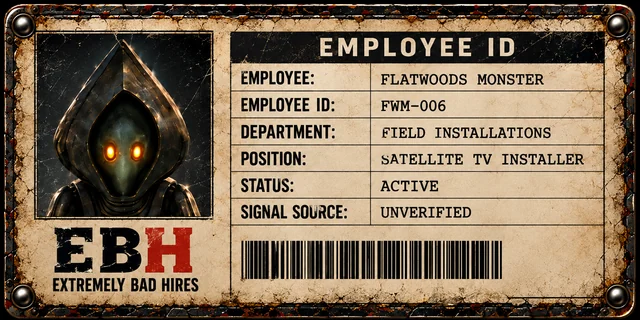 Employee ID / FWM-006
Flatwoods Monster
Satellite TV Installer
View dossierClose dossier
Flatwoods Monster
Satellite TV Installer
View dossierClose dossier01 / Background record
History / Lore / What Is It?
The Flatwoods Monster, also known as the Braxton County Monster, comes from a reported encounter near Flatwoods, West Virginia, on September 12, 1952. That evening, several local youths saw a bright object cross the sky and seem to descend beyond a nearby hill. Kathleen May and others joined them to investigate. Near the top of the hill, the group reported a pulsing red light and a towering humanlike figure with a reddish face set inside a pointed, hood-like or spade-shaped outline. Accounts differed on some details, but witnesses consistently described something unusually tall, dark-bodied, bright-eyed, and capable of gliding rather than walking. They also reported a harsh mist or odor at the scene, and some members of the group later complained of nausea or throat irritation. The story spread quickly through newspapers and radio and became one of West Virginia’s most famous unexplained encounters. Later skeptical explanations proposed that the light in the sky was a meteor and that an owl may have contributed to the frightening figure seen in the darkness. Those explanations have not ended the legend. The 1952 encounter remains closely tied to Braxton County, where the Flatwoods Monster is preserved through local history, museum displays, and community folklore.
02 / EBH Staffing
EBH Staffing Profile
Flatwoods Monster was assigned to Field Installations after completing a satellite alignment in twelve seconds without touching the signal meter, adjusting the dish, or explaining why every receiver in the building briefly displayed the same unknown channel. His installations are consistently perfect, but Engineering added Signal Source: Unverified to his personnel file after tracing one test signal past the approved satellite network, past every registered orbital position, and then losing it entirely. Customers frequently mistake him for the reason their television stopped working and tend to leave the property before he can ask anyone to hold the ladder. HR tried solving the problem with a reflective safety vest, which only produced a new complaint describing “a glowing-eyed road worker standing on the roof.” Flatwoods Monster has also been reminded that hovering beside a second-story dish is not an approved substitute for fall protection, even if technically no ladder was used. Despite the paperwork, his service record remains excellent: no missed appointments, no bad alignments, and almost no customers present long enough to argue about the bill. He doesn’t abduct anyone. He needs a second pair of hands and the locals keep running.
03 / Card appearances
In the deck
- Flatwoods Monster — Series 1 Hire
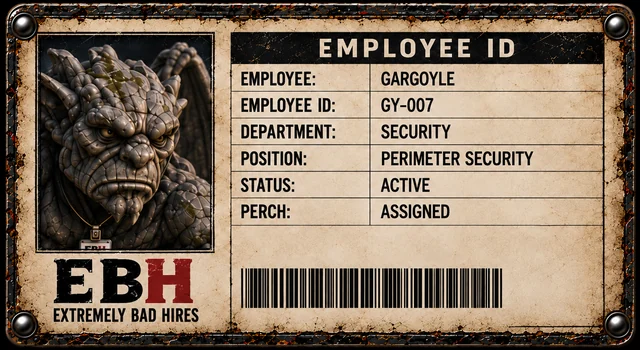 Employee ID / GY-007
Gargoyle
Perimeter Security
View dossierClose dossier
Gargoyle
Perimeter Security
View dossierClose dossier01 / Background record
History / Lore / What Is It?
A gargoyle is, first of all, an architectural waterspout. On medieval churches and other large stone buildings, gargoyles projected outward from roofs and gutters so rainwater could be carried away from the walls instead of running directly down the masonry. Carvers often turned these practical drains into animals, monsters, hybrids, and distorted human faces, giving the buildings some of their most memorable silhouettes. Not every frightening stone figure on a Gothic building is technically a gargoyle: if it does not channel water, it is better described as a grotesque or, in some contexts, a chimera. Scholars have proposed several meanings for these strange figures, including warning, humor, decoration, and protection; some medieval grotesques may have been intended to ward off evil, but there was no single meaning shared by every carving. The famous monsters on the upper galleries of Notre-Dame de Paris also illustrate how later art shaped the modern image of the gargoyle: many of its best-known chimeras were created during Eugène Viollet-le-Duc’s nineteenth-century restoration. The familiar fantasy idea of gargoyles awakening as living stone guardians is therefore a later invention built on the eerie appearance and watchful placement of real architectural sculpture.
02 / EBH Staffing
EBH Staffing Profile
Gargoyle was assigned to Security after EBH Staffing concluded that several centuries spent motionless above doorways counted as unusually relevant work experience. As Perimeter Security, he prefers elevated positions, direct sightlines, and absolutely no discussion about whether sitting perfectly still for six hours qualifies as an active patrol. His file lists Perch: Assigned, and Facilities has been instructed not to relocate him after the last crew moved his station twelve feet and spent the rest of the night filing reports about scratching sounds on the roof. Security cameras regularly show Gargoyle facing one direction in one frame and another direction in the next, with no footage explaining how he got there. Employees have stopped reporting him for sleeping on duty because every complaint comes back with a list of everything the complainant did while they thought he was asleep. Facilities occasionally forwards drainage tickets to him because a real gargoyle is technically a waterspout; he returns every request marked NOT SECURITY. His overnight evaluations remain excellent. He doesn't sleep. He just faces a different direction and calls it a shift change.
03 / Card appearances
In the deck
- Gargoyle — Series 1 Hire
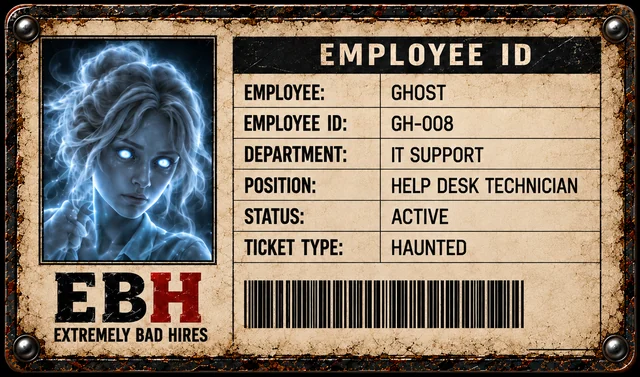 Employee ID / GH-008
Ghost
Help Desk Technician
View dossierClose dossier
Ghost
Help Desk Technician
View dossierClose dossier01 / Background record
History / Lore / What Is It?
Stories about the dead returning to the living appear in many cultures, but there is no single belief that defines what a ghost is everywhere. In folklore, a ghost may be understood as the spirit, presence, or visible apparition of a person who has died, and traditions differ widely on why the dead might return. Some accounts connect ghosts with improper burial, violent or unusual deaths, unfinished obligations, or strong ties to particular people and places. Others use ghost stories to express grief, memory, warning, guilt, or uncertainty about what happens after death. Ancient Mesopotamian beliefs, for example, placed great importance on proper burial and ritual because an unsettled dead person might return and trouble the living. In early modern England, ghost stories were closely connected with mourning, remembrance, religion, and questions about the fate of the soul. What witnesses claim to experience also varies: a recognizable figure, a voice, footsteps, moving objects, unexplained sensations, or simply the powerful feeling that someone is present. The familiar image of a pale transparent figure drifting through walls is therefore only one later visual shorthand for a much older and far more varied body of ghost belief.
02 / EBH Staffing
EBH Staffing Profile
Ghost was assigned to IT Support after EBH Staffing discovered she could reach a workstation without actually walking over to it, which immediately put her ahead of several previous help desk contractors. Her requests are routinely filed under Ticket Type: Haunted, although she insists most cases are ordinary user error with better atmosphere. Employees know she has connected to their computer when the cursor begins moving on its own, the monitor briefly dims, and a troubleshooting window opens before they finish saying, “I already restarted it.” She has a particular talent for printers, which management considers suspicious enough that nobody has asked how she does it. On overnight shifts she occasionally answers tickets before they are submitted, appears in dark monitors behind employees who swear they are working, and has been formally warned that whispering passwords through unplugged headsets is not an approved authentication method. Her closure notes remain brutally efficient: RESTARTED, PERMISSIONS FIXED, USER CAUSED ISSUE, and once, THE COMPUTER IS FINE. YOU ARE THE PROBLEM. Despite repeated complaints that her remote sessions feel “too remote,” her resolution time remains the best in the department. She doesn’t float through walls. She remote-desktops.
03 / Card appearances
In the deck
- Ghost — Series 1 Hire
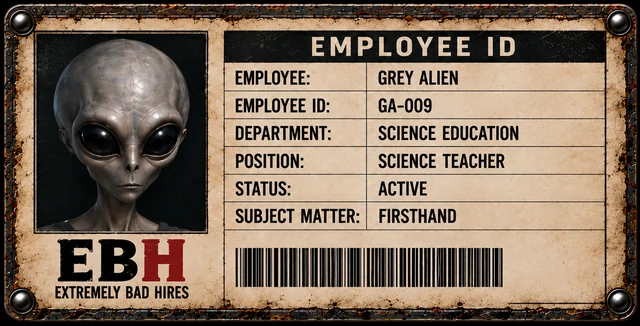 Employee ID / GA-009
Grey Alien
Science Teacher
View dossierClose dossier
Grey Alien
Science Teacher
View dossierClose dossier01 / Background record
History / Lore / What Is It?
The Grey Alien is a modern figure of UFO and alien-abduction folklore rather than an ancient mythological being. Today it is usually pictured as a small or slender humanoid with smooth gray skin, an oversized bald head, enormous dark eyes, and very little visible nose, mouth, or ears. That familiar image did not appear all at once. It developed during the twentieth century as UFO reports, alleged encounters, books, films, television, and later abduction stories began reinforcing a recognizable visual type. One of the most influential cases was the reported 1961 encounter of Betty and Barney Hill in New Hampshire. Their story became widely publicized in the mid-1960s and helped establish themes that later appeared repeatedly in abduction narratives, including missing time, medical examination, and small humanoid beings with large eyes. The broader American UFO era had already been growing since 1947, when a wave of sightings drew national attention and led the U.S. Air Force to begin formal investigations that eventually included Project Blue Book. By the 1980s and 1990s, books, films, television, and the widely recognized imagery associated with Whitley Strieber’s Communion helped make the large-headed, dark-eyed “Grey” an international pop-culture symbol of extraterrestrial visitors. Reported descriptions have never been completely consistent, however, and no scientifically verified evidence has established Grey Aliens as real extraterrestrial beings.
02 / EBH Staffing
EBH Staffing Profile
Grey Alien was assigned to Science Education after EBH Staffing discovered that Subject Matter: Firsthand was not a figure of speech. He teaches ordinary human science with the calm patience of someone who has already seen the answer key and is becoming increasingly concerned about the textbook. His astronomy lessons are exceptionally detailed, his star maps contain corrections nobody on staff is qualified to challenge, and three publishers have asked him to stop returning review copies covered in the word “INCOMPLETE.” Students generally describe him as fair, quiet, and deeply unsettling whenever a lesson begins with, “From your current understanding.” He has been reminded that field trips require signed permission slips after proposing an observational lab that listed the destination only as “above weather.” Grey Alien rarely raises his voice, never guesses, and has developed a reputation for staring silently at anyone who says the phrase “little green men” until they apologize without being asked. Administration remains extremely pleased with his test scores and considerably less pleased that he keeps correcting the section titled The Search for Life Beyond Earth in the first person. His most recent disciplinary note was filed after he failed a student for writing “aliens aren’t real.” Not because it’s wrong. Because it was rude.
03 / Card appearances
In the deck
- Grey Alien — Series 1 Hire
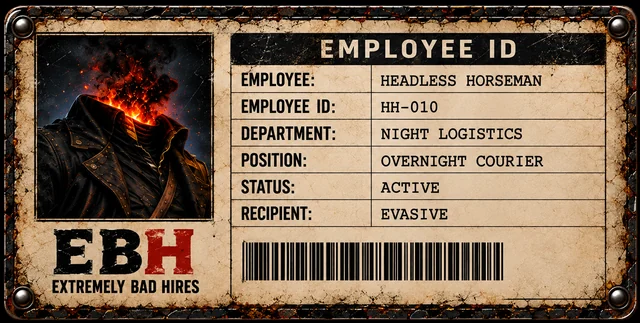 Employee ID / HH-010
Headless Horseman
Overnight Courier
View dossierClose dossier
Headless Horseman
Overnight Courier
View dossierClose dossier01 / Background record
History / Lore / What Is It?
The Headless Horseman is most closely identified with Washington Irving’s The Legend of Sleepy Hollow, first published in 1820 as part of The Sketch Book. In Irving’s story, residents of Sleepy Hollow tell of the ghost of a Hessian trooper whose head was carried away by a cannonball during the American Revolutionary War. His body is said to have been buried in the churchyard, while the rider leaves the grave at night in search of his missing head and races back before daybreak. The Horseman becomes the terrifying figure at the center of Ichabod Crane’s nighttime flight, but Irving deliberately leaves open the possibility that the encounter was a prank rather than a genuine haunting. Headless and spectral riders were not unique to Irving. Scholars and historians have pointed to earlier European traditions, including German tales of headless riders and the Irish Dullahan, as possible influences on the story. Even so, the Hessian Horseman of Sleepy Hollow is Irving’s own literary creation, shaped by those older motifs and by the Hudson Valley setting. Over the next two centuries, the character became one of the most recognizable ghostly figures in American literature and popular culture.
02 / EBH Staffing
EBH Staffing Profile
Headless Horseman joined Night Logistics after EBH Staffing discovered that a supernatural rider who has spent two centuries crossing dark roads at unreasonable speed requires very little courier training. His delivery times are excellent, his route compliance is impossible to verify, and no dispatcher has successfully explained how he reads street signs. The custom field Recipient: Evasive was added after management noticed that Headless Horseman does not recognize “customer unavailable” as a valid delivery outcome. Locked gates, disconnected doorbells, wrong addresses, and recipients hiding behind curtains are treated as minor routing complications. Night Logistics has also stopped requesting photographic proof of delivery after a month of images containing nothing but an empty road, a terrified horse, or a package already sitting inside a locked building. The biggest administrative problem remains signatures: forms are routinely returned scorched, hoof-marked, or somehow signed by the recipient several seconds before the door opens. Headless Horseman has never returned a package as undeliverable. HR calls that dedication. Legal has asked everyone to stop calling it that.
03 / Card appearances
In the deck
- Headless Horseman — Series 1 Hire
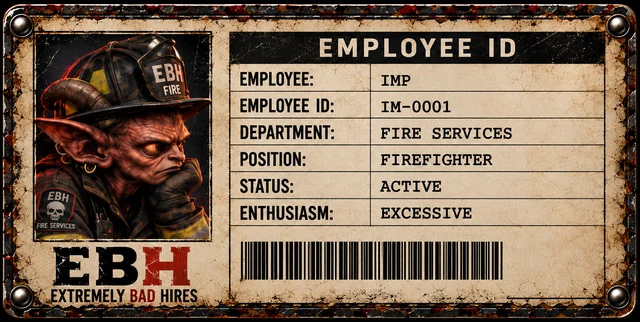 Employee ID / IM-0001
Imp
Firefighter
View dossierClose dossier
Imp
Firefighter
View dossierClose dossier01 / Background record
History / Lore / What Is It?
The English word imp did not originally describe a demon at all. Old English forms referred to a young shoot or graft, and the word later developed the sense of a child, offspring, or young scion. By the sixteenth century, phrases such as “imp of Satan” helped push the word toward its familiar supernatural meaning: a small devil, demon, or troublesome spirit. In early modern English witchcraft belief and trial literature, imps could overlap with the idea of familiar spirits—supernatural helpers that accused witches were said to keep or command, sometimes appearing in animal form. Those accounts belong to the history of witchcraft accusations and demonological writing rather than to one single, consistent folk creature. Later stories and art increasingly treated imps as minor supernatural troublemakers: small, mischievous, subordinate beings rather than powerful demons in their own right. Their exact appearance was never fixed. The now-familiar image of a tiny horned or winged creature is largely the result of later illustration, fantasy, games, and popular culture standardizing something older sources described far less consistently.
02 / EBH Staffing
EBH Staffing Profile
Imp was assigned to Fire Services after EBH Staffing concluded that an employee who becomes visibly happier when the alarm panel lights up should work somewhere supervisors can keep an eye on him. As a Firefighter, Imp is fast, fearless, compact enough to reach spaces larger crews cannot, and disturbingly good at locating the hottest part of an incident. The problem is enthusiasm. His file lists Enthusiasm: Excessive after several captains reported that he calls structure fires “promising,” asks whether controlled burns can be “a little less controlled,” and has been caught warming his hands during active suppression. Management has repeatedly explained that the objective is to put the fire out, not admire its development. He nods, agrees, and requests the nozzle with the expression of someone being handed front-row tickets. Despite the concern, his rescue record is excellent, his turnout time is nearly impossible to beat, and he has never abandoned a crew member. Fire Services currently operates under a simple compromise: one hose, two supervisors, and absolutely no unsupervised access to the ignition-investigation evidence locker.
03 / Card appearances
In the deck
- Imp — Series 1 Hire
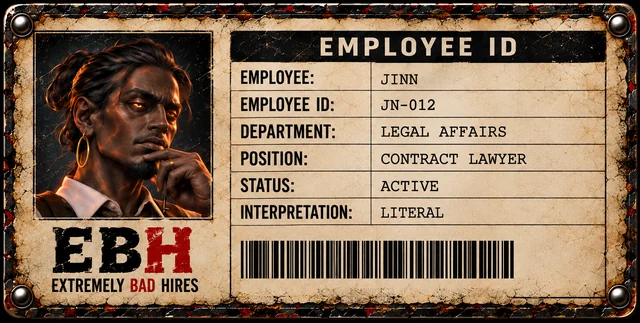 Employee ID / JN-012
Jinn
Contract Lawyer
View dossierClose dossier
Jinn
Contract Lawyer
View dossierClose dossier01 / Background record
History / Lore / What Is It?
In Islamic tradition, jinn are a distinct class of unseen beings with intelligence, choice, and moral responsibility. The Qur'an describes them as created from a smokeless flame of fire and, in Surah al-Jinn, presents jinn who follow different paths, including some who are righteous and others who are not. That makes the common idea that all jinn are evil an oversimplification. Islamic tradition also connects Solomon (Sulayman) with authority over jinn, a theme that later appeared widely in stories, talismans, and works of art. Beyond religious texts, jinn became part of a large body of Middle Eastern and Islamic storytelling in which their appearances, powers, motives, and relationships with humans vary greatly. The Western word "genie" comes from this tradition, but the familiar image of a lamp-bound servant who must grant wishes is only one later literary and popular-culture version. European translations and adaptations of stories associated with One Thousand and One Nights helped reshape the jinn into the wish-granting genie recognized around the world today. Traditional jinn are far broader and less predictable than that single image suggests.
02 / EBH Staffing
EBH Staffing Profile
Jinn entered Legal Affairs after EBH Staffing discovered that nobody in the building could weaponize a sentence quite as efficiently as he could. As Contract Lawyer, Jinn reviews every agreement with Interpretation: Literal, which has reduced drafting errors while increasing the average contract from six pages to forty-three. Employees are strongly advised not to use the phrases "I wish," "whatever it takes," or "do whatever you think is best" anywhere within earshot of his office. Jinn insists that he does not exploit loopholes; he merely honors the exact language provided, a distinction Legal considers both technically correct and deeply unhelpful. During negotiations he is polite, patient, and almost impossible to surprise, although opposing counsel has complained that he smiles whenever someone says, "You know what I meant." His contracts now include definitions for common words, uncommon words, metaphors, gestures, sighs, and one entire appendix explaining the legal meaning of "close enough." Management's current policy is simple: read everything twice, sign nothing in pencil, and never make a casual wish near Jinn unless you are prepared to receive exactly what you asked for.
03 / Card appearances
In the deck
- Jinn — Series 1 Hire
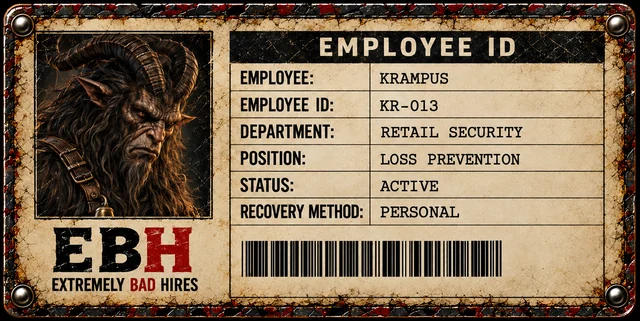 Employee ID / KR-013
Krampus
Loss Prevention
View dossierClose dossier
Krampus
Loss Prevention
View dossierClose dossier01 / Background record
History / Lore / What Is It?
Krampus is a devil-like figure from Alpine winter tradition, especially in Austria and other German-speaking parts of central Europe. He appears in connection with Saint Nicholas around December 5 and 6, serving as the frightening counterpart to the saint’s rewards for well-behaved children. Traditional portrayals commonly give Krampus horns, shaggy fur, heavy bells, chains, and a switch or bundle of birch twigs used to threaten or punish the badly behaved. The custom remains visible today in Krampusläufe, or Krampus runs, where costumed participants move through streets and villages in elaborate carved masks and animal pelts. Krampus is related to the wider world of Alpine winter customs but is not the same figure as the Perchten, whose traditions and seasonal roles differ. Claims that Krampus is simply a surviving pre-Christian god or pagan monster are difficult to prove. Folklore research points more clearly to medieval devil imagery, religious drama, Saint Nicholas traditions, and later processions as major parts of his development. In the late nineteenth and early twentieth centuries, illustrated Krampus postcards helped spread his image far beyond the communities where the custom was practiced. Modern horror often presents Krampus as an independent Christmas monster, but in the older tradition he is usually understood in relation to Saint Nicholas and the seasonal lesson of reward and punishment.
02 / EBH Staffing
EBH Staffing Profile
Krampus was placed in Retail Security after EBH Staffing noticed that inventory shrinkage dropped sharply whenever he stood near an exit and looked disappointed. As Loss Prevention, Krampus takes Recovery Method: Personal very seriously. He calls unpaid merchandise “naughty inventory” and returns every recovered item with a handwritten report beginning, “They knew better.” Management has repeatedly asked him to leave the chains in the security office and stop carrying birch switches during routine floor walks; he has complied with one of those requests, although nobody is certain which one. His numbers are exceptional, but the seasonal toy aisle requested reassignment after three children confessed to incidents that occurred years before Krampus was hired. Surveillance also reports that he knows when merchandise has been concealed before the cameras do, which he lists under professional experience as “December.” EBH Staffing rates him as highly effective. Retail management agrees, provided nobody asks about customer retention. Current policy: if Krampus says he will handle the recovery personally, give him the incident number, unlock the security door, and do not schedule the store Santa in the same hallway.
03 / Card appearances
In the deck
- Krampus — Series 1 Hire
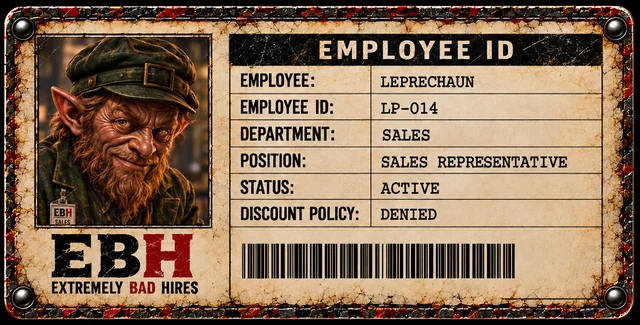 Employee ID / LP-014
Leprechaun
Sales Representative
View dossierClose dossier
Leprechaun
Sales Representative
View dossierClose dossier01 / Background record
History / Lore / What Is It?
The leprechaun is one of the best-known figures in Irish fairy folklore, but traditional accounts are less uniform than the modern green-suited mascot suggests. Irish folklore collections commonly describe a very small male fairy whose trade is shoemaking. The sound of tapping or hammering on a tiny shoe can reveal that one is nearby, often around a fort, rath, lone bush, or other place associated with the fairies. Leprechauns are also strongly linked with hidden money. In many stories, a person who manages to catch one demands to be shown a crock, purse, or other store of gold, but the captor must keep watching closely. The leprechaun distracts, deceives, or startles the person into looking away and then escapes. Clothing varies from account to account. Records in the National Folklore Collection describe red, green, blue, or mixed clothing, with red appearing often enough to challenge the now-familiar all-green image. The rainbow, top hat, and cheerful good-luck mascot are later popular-culture additions rather than a complete picture of the older stories. Traditional leprechauns are better understood as clever, elusive fairy shoemakers whose treasure is much easier to demand than to obtain.
02 / EBH Staffing
EBH Staffing Profile
Leprechaun was placed in Sales after EBH Staffing discovered that he could turn a casual question into a signed order before the customer remembered asking it. His file lists Discount Policy: Denied, and Sales confirms this is not a guideline, a negotiating position, or the beginning of a conversation. Leprechaun knows every price, every margin, every expired promotion, and exactly how long a customer has been staring at the cheaper option. He has been warned repeatedly that hiding the final copy of a contract does not make the sale more binding, although Legal admits the paperwork has remained technically flawless. Prospective clients report that negotiations become strangely difficult the moment they take their eyes off him, and one regional manager spent forty minutes following the sound of tiny hammering only to discover six newly polished dress shoes and no employee. Leprechaun consistently exceeds quota, refuses to explain where he keeps the commission checks, and has never approved a markdown in company history. His preferred closing line is simple: “That is the price.” Sales has tried adding “final offer” afterward. He considers that a discount.
03 / Card appearances
In the deck
- Leprechaun — Series 1 Hire
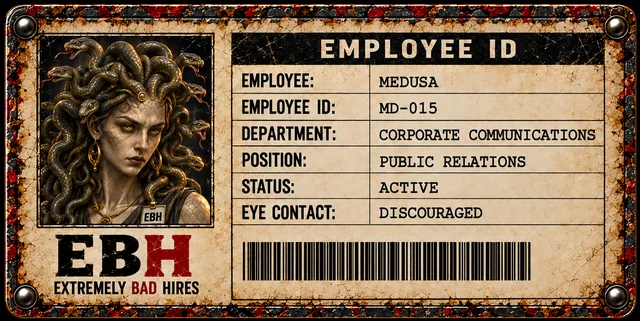 Employee ID / MD-015
Medusa
Public Relations
View dossierClose dossier
Medusa
Public Relations
View dossierClose dossier01 / Background record
History / Lore / What Is It?
Medusa is the most famous of the three Gorgons in ancient Greek mythology. In Hesiod’s Theogony, she is the only mortal sister of Stheno and Euryale. Perseus eventually beheads her, and from her severed neck spring Pegasus, the winged horse, and Chrysaor. Early Greek art did not usually present Medusa as the beautiful woman familiar from later images. Archaic Gorgons could have staring eyes, bared teeth or tusks, protruding tongues, wings, and other monstrous features meant to confront the viewer. From the Classical period onward, artists increasingly made Medusa more human and beautiful while preserving the snakes and petrifying gaze that became central to her identity. A later Roman version in Ovid’s Metamorphoses gives Medusa a different background: she had once been renowned for her beauty before an encounter with Neptune (Poseidon) in Minerva’s (Athena’s) temple, after which Minerva transformed Medusa’s hair into snakes. That story is influential, but it is later than the older Greek traditions and should not be treated as Medusa’s single original origin. Even after her death, Medusa’s head retains its deadly power, and Perseus eventually gives it to Athena. The Gorgon face, or gorgoneion, also became a widespread protective image in Greek art, appearing on temples, armor, jewelry, and other objects as a symbol meant to ward off danger.
02 / EBH Staffing
EBH Staffing Profile
Medusa was assigned to Corporate Communications after EBH Staffing decided that anyone capable of ending a hostile press conference with a single glance probably understood message control. As Public Relations, Medusa is calm, prepared, and exceptionally effective at keeping reporters focused on approved talking points, although all media briefings now begin with a reminder that Eye Contact: Discouraged. Camera crews are instructed to use side angles, reflective monitors, or the company-approved “look literally anywhere else” protocol. Her crisis-management record is nearly spotless, partly because difficult follow-up questions tend to stop the moment she lowers her sunglasses. HR has received complaints that this creates an intimidating work environment; Medusa has responded that she cannot be held responsible for employees who ignore clearly posted signage, three orientation videos, and a laminated card titled DO NOT STARE AT THE PR REPRESENTATIVE. Corporate considers her especially valuable during scandals, product recalls, and executive apologies. Public sentiment remains difficult to measure, but every focus group assigned to her last campaign was described as “remarkably still.”
03 / Card appearances
In the deck
- Medusa — Series 1 Hire
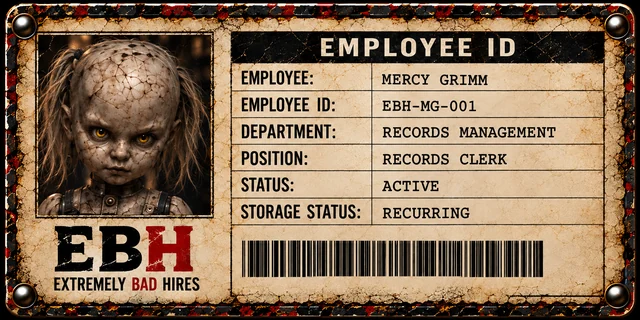 Employee ID / EBH-MG-001
Mercy Grimm
Records Clerk
View dossierClose dossier
Mercy Grimm
Records Clerk
View dossierClose dossier01 / Background record
History / Lore / What Is It?
Mercy Grimm, sometimes called The Hollow Child, is a singular manufactured entity standing roughly two feet tall. She resembles an aged composition doll, with a cracked manufactured face, small deep-set amber eyes, sparse rooted hair, exposed joints, and old institutional clothing. No verified maker, origin date, or first owner has ever been established, but one persistent story places Mercy in the early 1900s, when she was supposedly given to a little girl as a birthday present. According to the rumor, the child was tormented by local bullies and later met a horrific and untimely death connected to them. Sometime afterward, people began claiming that the doll would not remain where it was left and that those who had harmed the girl began suffering frightening accidents, disappearances, or worse. The theory that followed was simple: the child had never truly left Mercy, and the doll had become a vessel through which she could seek revenge. No surviving record has ever confirmed the girl’s identity, the circumstances of her death, or even whether the birthday story happened at all. Mercy offers no answers. She watches, moves only when she chooses, and continues to return after attempts to store, discard, or relocate her. Whether she carries the spirit of a murdered child, something that merely learned the story, or nothing anyone has correctly understood remains unknown.
02 / EBH Staffing
EBH Staffing Profile
Mercy Grimm works in Records Management as a Records Clerk, which would be less concerning if anyone could locate the paperwork showing who hired her. Mercy is unnervingly efficient: missing folders return to the correct cabinet, misfiled records appear on desks before they are requested, and her own employee file remains ACTIVE no matter how many people try to close it. Storage Status: Recurring was added after staff returned her to storage three separate times and found her clocked in again before the next shift. She does not argue with supervisors, take breaks, or respond to disciplinary meetings; she simply resumes filing with the calm focus of someone who has already seen the final version of the paperwork. HR once confiscated her badge during another removal attempt. The next morning Mercy was back at the records cart, badge in place, filing the incident report under her own name. Nobody admits opening the storage box. Nobody remembers hiring her. The records insist otherwise. Badge was confiscated. Employee returned wearing it.
03 / Card appearances
In the deck
- Mercy Grimm — Series 1 Hire
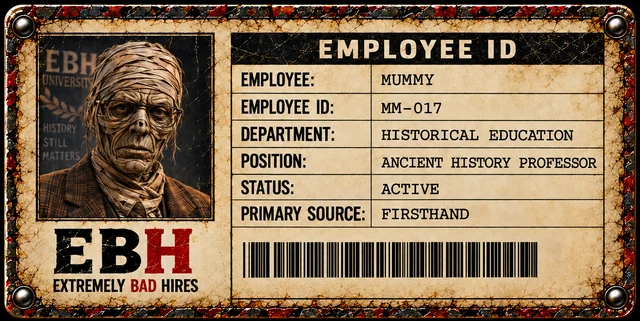 Employee ID / MM-017
Mummy
Ancient History Professor
View dossierClose dossier
Mummy
Ancient History Professor
View dossierClose dossier01 / Background record
History / Lore / What Is It?
A mummy is a human or animal body preserved after death, either by natural conditions or by deliberate treatment. Many cultures produced mummies, but ancient Egypt became especially famous for deliberate mummification because preserving the body was closely connected with beliefs about continued existence in the afterlife. Egyptian methods changed over thousands of years and were not identical in every period or for every person. In many well-documented forms of the practice, embalmers removed most internal organs, dried the body with natron, treated it with oils and resins, and wrapped it carefully in linen. Coffins, funerary masks, amulets, texts, offerings, and other objects could help protect the deceased and support the journey into the next life. The goal was preservation and religious preparation, not the creation of a monster. The familiar horror image of a bandaged corpse rising from its tomb and carrying an ancient curse developed much later. Nineteenth- and twentieth-century Egyptomania, sensational reporting, literature, and especially the publicity surrounding the discovery of Tutankhamun’s tomb helped turn the mummy into a stock figure of Western horror. Real ancient Egyptian funerary beliefs were far more complex, and the preserved dead were treated as people preparing for continued existence rather than creatures expected to return and attack the living.
02 / EBH Staffing
EBH Staffing Profile
Mummy was hired by Historical Education after correcting three textbooks, two museum placards, and an entire faculty meeting without consulting a single reference. His personnel file lists Primary Source: Firsthand, which was originally entered as a joke and became official after he began identifying archaeological sites by remembering where the exits used to be. As Ancient History Professor, Mummy is patient with students, less patient with documentaries, and openly offended by the phrase “nobody knows for sure” when he does, in fact, know for sure. He has been asked repeatedly to stop beginning lectures with “I remember this differently,” particularly when the assigned reading describes events he claims were badly reported even at the time. Course evaluations praise his depth of knowledge but note that office hours can become uncomfortable when students ask how old he is, whether a pharaoh was “actually like that,” or why he keeps calling several-thousand-year-old artifacts “the newer stuff.” The department considers him an irreplaceable academic resource. Records Management considers his employment history impossible to verify. Mummy considers both opinions historically recent.
03 / Card appearances
In the deck
- Mummy — Series 1 Hire
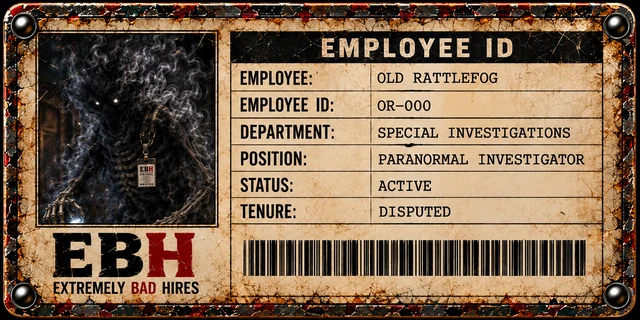 Employee ID / OR-000
Old Rattlefog
Paranormal Investigator
View dossierClose dossier
Old Rattlefog
Paranormal Investigator
View dossierClose dossier01 / Background record
History / Lore / What Is It?
Old Rattlefog is a tall, thin humanoid entity most often associated with scattered reports from the Appalachian region, although no reliable record establishes where he came from, what he is, or how long he has existed. Witnesses describe a body made of dense, living smoke rather than flesh, with fragments of bone and portions of a ribcage appearing inside the shifting vapor before disappearing again. His face rarely forms clearly, but two small reflective eyes can catch a flashlight beam from surprisingly far away. Older accounts describe him standing quietly at the edge of strange events rather than causing them: near abandoned buildings, unexplained lights, reported hauntings, and places where witnesses already believed something was wrong. He is usually described as patient, observant, and nonaggressive, sometimes answering a frightened witness only with a slow nod before fading back into darkness or smoke. The name Old Rattlefog appears in records whose dates do not agree with one another, and nobody has established who used it first. Some investigators believe he is drawn to paranormal activity. Others suspect he has been studying it far longer than they have. A less comfortable theory suggests the distinction between investigator and phenomenon may not apply to him at all.
02 / EBH Staffing
EBH Staffing Profile
Old Rattlefog works in Special Investigations because EBH Staffing eventually decided that asking why he already had access to the department was less productive than giving him a badge. His personnel file lists Tenure: Disputed after Payroll located employment records bearing his ID number from before the current records system, before the department was renamed, and in one case before anyone can prove the company occupied the building. Old Rattlefog is considered an excellent Paranormal Investigator: he is quiet on surveillance, impossible to startle, and somehow knows which dark hallway is worth checking without being told. Unfortunately, motion sensors occasionally classify him as smoke, thermal cameras disagree about whether he is present, and EMF readings become useless whenever he stands too close to the equipment. Coworkers report that he arrives early, never calls off, and has never once been seen entering the building. He is generally cooperative, communicates mostly through small gestures and prolonged staring, and has repeatedly returned case files that Records insists were never issued to him. HR asked for paranormal experience. Nobody specified which side of the investigation.
03 / Card appearances
In the deck
- Old Rattlefog — Series 1 Hire
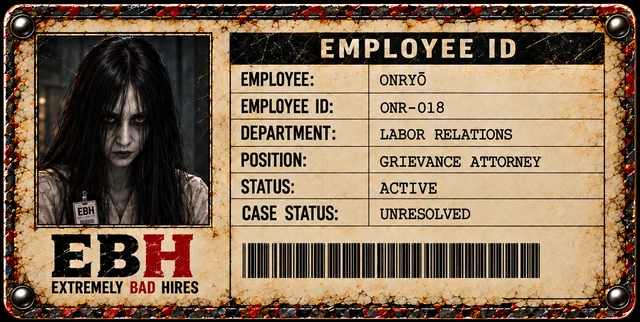 Employee ID / ONR-018
Onryō
Grievance Attorney
View dossierClose dossier
Onryō
Grievance Attorney
View dossierClose dossier01 / Background record
History / Lore / What Is It?
In Japanese ghost tradition, an onryō is a spirit driven by powerful resentment or an unresolved wrong. The idea appears throughout Japanese history in stories about people who died after betrayal, disgrace, injustice, or intense suffering and were then believed capable of bringing illness, disaster, or misfortune to the living. These spirits were not always treated simply as monsters to be destroyed. Appeasing, honoring, or ritually calming an angry dead person could be understood as a way to restore order. One of the best-known historical examples is Sugawara no Michizane, the scholar and statesman who died in exile in 903. Later calamities were blamed on his vengeful spirit, and efforts to pacify him eventually contributed to his deification as Tenjin. Centuries later, theater and print culture made more personal revenge ghosts famous, including Oiwa from Yotsuya Kaidan, whose betrayal and death lead to supernatural vengeance. Onryō are often discussed alongside yūrei, the broader category of Japanese ghosts and apparitions, but the terms are not identical: an onryō is defined especially by grievance and vengeance. The pale face, long dark hair, and white clothing familiar from later Japanese ghost imagery became highly influential, but no single appearance represents every onryō story.
02 / EBH Staffing
EBH Staffing Profile
Onryō was assigned to Labor Relations after HR discovered that no employee in the building understood an unresolved grievance quite as personally as she did. As Grievance Attorney, Onryō reviews complaints with absolute patience, perfect recall, and a disturbing refusal to accept the phrase "we consider this matter closed." Her file lists Case Status: Unresolved, which Legal originally believed referred to her workload until Records confirmed it also appears on her own personnel history. Managers are strongly advised to document every conversation, avoid retaliatory scheduling, and never tell Onryō that an employee should "just let it go." Previous supervisors who used that wording reported lights failing, printer trays filling with duplicate grievance forms, and a woman with long black hair appearing in conference-room glass after everyone else had gone home. Despite the complaints, her settlement record is excellent. Most disputes are resolved within forty-eight hours, usually shortly after the opposing party requests an immediate meeting and agrees to every term. Onryō does not raise her voice, threaten anyone, or rush negotiations. She simply keeps the case open until the grievance has been answered. Labor Relations calls that persistence. Everyone else considers it a very good reason not to leave unresolved paperwork overnight.
03 / Card appearances
In the deck
- Onryō — Series 1 Hire
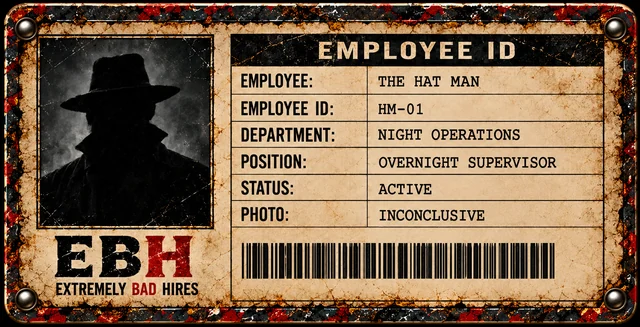 Employee ID / HM-01
The Hat Man
Overnight Supervisor
View dossierClose dossier
The Hat Man
Overnight Supervisor
View dossierClose dossier01 / Background record
History / Lore / What Is It?
The Hat Man is a modern paranormal and internet-folklore figure most often described in connection with sleep paralysis and encounters with so-called shadow people. Reports commonly describe a tall, human-shaped silhouette with little or no visible face, a wide-brimmed hat, and sometimes a long coat. He is often said to stand in a doorway, corner, hallway, or beside the bed, watching silently while the witness experiences an intense sense of dread. Accounts using the specific name “Hat Man” began circulating widely online in the late 2000s, but frightening humanlike presences during the boundary between sleep and waking are much older and appear in many cultures under different names and explanations. Sleep paralysis is a documented sleep phenomenon in which conscious awareness returns while the temporary muscle paralysis associated with REM sleep has not fully ended. Episodes can include fear, pressure sensations, a strong sense that someone or something is present, and vivid hallucinations of figures or intruders. Because of that overlap, researchers often discuss shadow-person and Hat Man reports as contemporary folklore shaped around a real sleep phenomenon, while some experiencers interpret the figure as an independent paranormal entity. No verified evidence has established the Hat Man as a separate physical or supernatural being. The mystery of why so many reports describe a similar hat-wearing silhouette remains part of the legend.
02 / EBH Staffing
EBH Staffing Profile
The Hat Man was placed in Night Operations after management discovered that employee productivity improves dramatically when everyone believes a silent figure may be standing behind them. As Overnight Supervisor, The Hat Man rarely gives instructions, never schedules meetings, and has not submitted a single written performance review; employees simply find him at the far end of a hallway and immediately remember what they were supposed to be doing. His personnel file lists Photo: Inconclusive because security cameras consistently capture either an empty corridor, a dark blur, or a perfectly clear image of everything except the person wearing the hat. Attempts to confirm his hours have been equally unsuccessful. Timecards show The Hat Man clocking in before some shifts begin, after others end, and occasionally on nights when the building was officially closed. Staff complaints describe prolonged staring, unexplained appearances in locked rooms, and an uncomfortable habit of becoming visible only after someone says, “I thought I was alone.” HR has repeatedly asked him to announce himself when approaching employees from behind. Compliance remains pending because nobody is willing to deliver the memo. Night Operations considers him an effective supervisor. Nobody has ever seen him leave.
03 / Card appearances
In the deck
- The Hat Man — Series 1 Hire
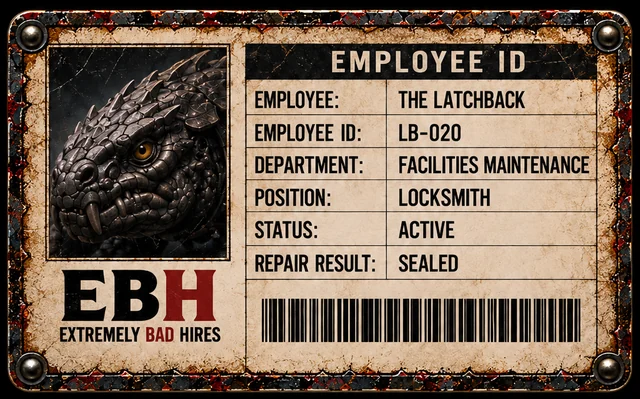 Employee ID / LB-020
The Latchback
Locksmith
View dossierClose dossier
The Latchback
Locksmith
View dossierClose dossier01 / Background record
History / Lore / What Is It?
The Latchback is a heavy threshold creature whose behavior centers on boundaries: doors, gates, hatches, chains, shutters, and anything meant to separate one space from another. Field descriptions portray a low, wedge-shaped quadruped built more like a living barricade than an animal. Its back is armored with overlapping plates resembling latches or locking hardware, while powerful forelimbs and a bracing tail let it plant itself against an opening with remarkable force. The Latchback does not appear to hunt people or guard valuables in the ordinary sense. Instead, it seems compelled by the state of closure itself. Once it decides that something is supposed to be shut, warped frames settle, loose hardware draws tight, gaps vanish, and repeated attempts to reopen the barrier only make the creature brace harder. Witnesses often describe it as patient, stubborn, and almost proud when a seal holds. No reliable account explains where it came from or why it recognizes doors and barriers so instinctively. The most consistent observation is simpler: The Latchback does not guard the door. It guards the concept of closed.
02 / EBH Staffing
EBH Staffing Profile
The Latchback was hired by Facilities Maintenance because, on paper, “can permanently secure any access point” sounded exactly like a locksmith qualification. In practice, The Latchback treats “repair the lock,” “secure the door,” and “make sure nobody gets in” as identical instructions, and has yet to demonstrate any interest in the part where the door is expected to open again. His file lists Repair Result: Sealed, which Facilities considers less of a performance metric than a warning. Keys routinely become decorative objects after he finishes a job, replacement hinges have been found fused against the frame, and one emergency exit remained so thoroughly closed that the building inspector recommended moving the wall instead. The Latchback is not destructive out of spite; he is literal-minded, task-compliant, deeply proud of his work, and visibly offended by anyone attempting to undo it. Management has therefore added “REOPENABLE” in red ink to every work order assigned to The Latchback. Results have not improved. Facilities called him to fix the lock. He solved the lock and destroyed the concept of reopening it.
03 / Card appearances
In the deck
- The Latchback — Series 1 Hire
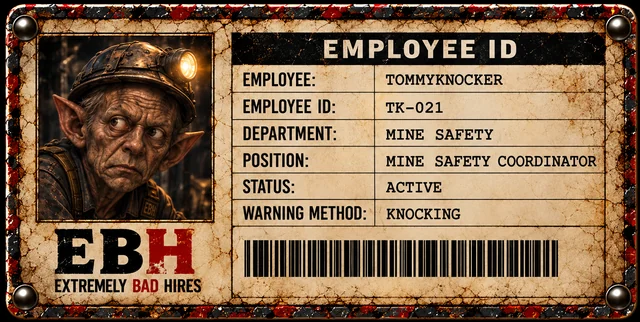 Employee ID / TK-021
Tommyknocker
Mine Safety Coordinator
View dossierClose dossier
Tommyknocker
Mine Safety Coordinator
View dossierClose dossier01 / Background record
History / Lore / What Is It?
Tommyknockers descend from the mining folklore of Cornwall, where related underground beings were more commonly called knockers. They were imagined as supernatural miners or small spirit-like inhabitants of the workings, heard through tapping and knocking in places where no human worker was standing. Their behavior could be helpful or hostile. Some stories credited knockers with guiding worthy miners toward valuable ore, while others said their sounds warned of unsafe rock, failing timbers, water, or an approaching cave-in. Miners who angered them might instead suffer missing tools, bad luck, or other underground trouble. Offerings of food were sometimes left for the spirits, including bread or pieces of a miner's pasty, both as a gesture of respect and in hopes of keeping their favor. During the nineteenth century, Cornish miners carried these traditions across the Atlantic and throughout mining regions of North America. In the American West, the name tommyknocker became especially familiar, and the warning-knock before underground danger became one of the strongest parts of the legend. Some American versions described tommyknockers as the spirits of miners who had died below ground, but that explanation was never universal. Across both Cornish and American traditions, the practical lesson was simple: if unexplained knocking starts in a mine, pay attention.
02 / EBH Staffing
EBH Staffing Profile
Tommyknocker joined Mine Safety after management realized he had been conducting inspections for several weeks without being hired, scheduled, or visible on any camera. As Mine Safety Coordinator, Tommyknocker refuses radios, alarms, email, and every other communication system purchased after 1890. His file lists Warning Method: Knocking, which sounds primitive until the support beam he taps fails inspection six minutes later. Crews have learned that one knock means pay attention, two means check the structure, and repeated knocking means stop asking questions and move. Safety attempted to formalize the pattern in a training manual, but Tommyknocker changed the sequence halfway through the presentation by knocking from inside a sealed wall. He also confiscates unattended tools, relocates lunches, and becomes noticeably less cooperative when nobody leaves him a piece of something edible at the end of a shift. HR has classified these incidents as "traditional motivational practices" because nobody wanted to write "appease the mine spirit" on an OSHA-facing document. His incident-prevention numbers remain excellent, his paperwork remains blank, and every veteran crew agrees on the same emergency procedure: if Tommyknocker starts pounding on the wall, you can ask what it means after you are above ground.
03 / Card appearances
In the deck
- Tommyknocker — Series 1 Hire
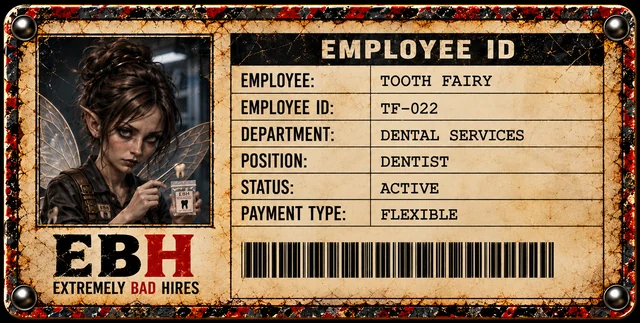 Employee ID / TF-022
Tooth Fairy
Dentist
View dossierClose dossier
Tooth Fairy
Dentist
View dossierClose dossier01 / Background record
History / Lore / What Is It?
The Tooth Fairy is a relatively modern childhood folklore figure rather than an ancient fairy with one continuous traditional history. In the version now familiar across the United States and many other countries, a child places a lost baby tooth under a pillow or near the bed, and during the night the Tooth Fairy takes it and leaves money or a small gift in exchange. Customs surrounding lost teeth are much older and far more varied. Around the world, children and families have buried, hidden, thrown, saved, offered, or otherwise disposed of baby teeth according to local beliefs about protection, luck, healthy replacement teeth, or the safe handling of something that once belonged to the body. Some traditions use a mouse rather than a fairy; Ratoncito Pérez, for example, is a familiar tooth-collecting figure in Spain and much of Latin America. In the United States, the modern pillow ritual was already circulating by the early twentieth century, while the specific Tooth Fairy character became increasingly recognizable during the decades around World War II and after. Museum research traces the familiar American figure to a blend of older tooth customs, fairy lore, and changing ideas about childhood. Whatever its exact path of development, the tradition turns the loss of a tooth from something unsettling into a small rite of passage marked by attention, reward, and a little mystery.
02 / EBH Staffing
EBH Staffing Profile
Tooth Fairy was assigned to Dental Services after EBH Staffing decided that anyone with generations of experience collecting detached teeth probably met the minimum qualifications. As Dentist, Tooth Fairy has excellent chairside manner, flawless extraction technique, and a reimbursement system Accounting describes as “deeply backwards.” Her file lists Payment Type: Flexible because she has been known to accept cash, insurance, loose change, baby teeth, and on one occasion a molar placed beneath a break-room pillow with the correct paperwork attached. Patients are regularly confused when an extraction ends with Tooth Fairy handing them money instead of a bill, although the amount appears to depend on tooth condition, sentimental value, and whatever mysterious exchange rate she is using that week. She becomes visibly irritated when adults ask whether crowns count as “real teeth” and has permanently banned Finance from using the phrase “fair market value.” Dental Services also requires staff to label all specimen bags after three extracted teeth disappeared overnight and were replaced with six dollars and a handwritten receipt. Her clinical results are excellent. Her billing practices are indefensible. Nobody in Accounts Receivable has had the courage to tell her she is supposed to charge the patient.
03 / Card appearances
In the deck
- Tooth Fairy — Series 1 Hire
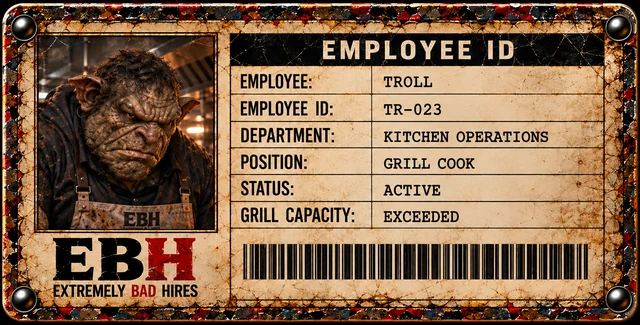 Employee ID / TR-023
Troll
Grill Cook
View dossierClose dossier
Troll
Grill Cook
View dossierClose dossier01 / Background record
History / Lore / What Is It?
Trolls are supernatural beings from Norse and later Scandinavian tradition, but the word has never described one single creature with a fixed appearance or personality. In Old Norse usage, troll could refer broadly to strange or threatening nonhuman beings, and later Norwegian folklore continued to portray trolls in many forms. Some are enormous, grotesque, and frightening; others are smaller or more humanlike. They are often associated with remote mountains, caves, forests, and other places beyond ordinary settlement. Norwegian folktales frequently describe trolls as physically powerful but easier to defeat through cleverness than through strength, with human heroes surviving by tricking or outthinking them. Many well-known stories also connect trolls with darkness and the danger of sunlight, sometimes saying that dawn turns them to stone. During the nineteenth century, collectors Peter Christen Asbjørnsen and Jørgen Moe helped preserve numerous troll tales, while artists such as Erik Werenskiold and especially Theodor Kittelsen gave the creatures visual forms that strongly shaped the modern Norwegian image of the troll. The famous troll beneath a bridge is one memorable folktale motif—seen in The Three Billy Goats Gruff—not a rule that applies to every troll tradition.
02 / EBH Staffing
EBH Staffing Profile
Troll was transferred to Kitchen Operations after management realized that his definition of “high-volume cooking” began where the building’s definition of fire code ended. As Grill Cook, Troll can run every burner, flat-top, broiler, and fryer at once while still complaining that the kitchen is “barely warm.” His file lists Grill Capacity: Exceeded because three replacement griddles have warped under portions he described as “snacks,” and Facilities has stopped asking why the exhaust hood occasionally growls back. Troll is fast, consistent, and fiercely territorial about his station; touching his spatula without permission has resulted in two written warnings, one dented refrigerator door, and a line cook voluntarily transferring to Payroll. He also refuses to use timers, insisting that food is done when it “smells afraid,” a method Food Safety has been unable to translate into measurable policy. Customer complaints about portion size are nonexistent. Complaints about presentation usually end when Troll leans through the service window and asks whether they would like to discuss it in person. Kitchen Operations considers him one of its most productive employees. The last manager who asked how many burgers he could cook at once received a simple answer: “All of them.”
03 / Card appearances
In the deck
- Troll — Series 1 Hire
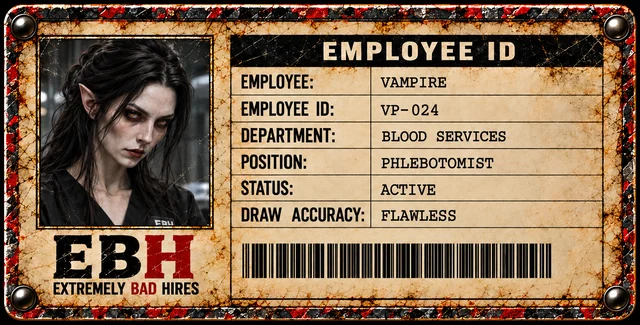 Employee ID / VP-024
Vampire
Phlebotomist
View dossierClose dossier
Vampire
Phlebotomist
View dossierClose dossier01 / Background record
History / Lore / What Is It?
Vampire traditions vary widely, but the figure familiar today grew especially from beliefs about restless or harmful dead people in Eastern and Southeastern Europe. In many older accounts, the suspected vampire was not an elegant aristocrat but a corpse believed to have returned from the grave to trouble relatives, neighbors, or livestock. Clusters of unexplained illness or death, along with ordinary signs of decomposition that seemed unusual to frightened communities, could be interpreted as evidence that the dead person was still active. Responses varied by place, but communities sometimes opened graves and used measures such as staking, decapitation, burning, or other local rites to prevent the corpse from returning. Reports from Serbia and neighboring Balkan regions in the early eighteenth century helped spread the word vampire through Western Europe and triggered serious debate among officials, clergy, physicians, and scholars about whether such beings could exist. During the nineteenth century, literature transformed the older revenant into a more refined, seductive, and aristocratic figure. Many traits now treated as standard vampire rules - including familiar ideas about mirrors, invitations, sunlight, and courtly behavior - were shaped heavily by fiction, theater, and film rather than by one single traditional folklore system.
02 / EBH Staffing
EBH Staffing Profile
Vampire was assigned to Blood Services after EBH Staffing determined that her previous experience was technically relevant and chose not to ask how previous. As Phlebotomist, Vampire has Draw Accuracy: Flawless and can locate a usable vein before the patient has finished rolling up a sleeve. Patients routinely praise the painless collection process right up until she asks whether the extra tube is “for quality control.” Laboratory staff have reminded her that every vial requires a test order, a label, and a reason, and that “I was curious” is not an accepted diagnostic code. She keeps the collection cart immaculate, never misses a draw, and becomes visibly offended when anyone refers to expired samples as “a waste.” HR has also prohibited the phrases “all you can draw,” “house red,” and “employee discount” anywhere in Blood Services. Despite these concerns, Vampire maintains one of the department’s highest patient-satisfaction scores. Most complaints come from Accounting, which still cannot explain why her supply requests include twice as many specimen tubes as the clinic has patients.
03 / Card appearances
In the deck
- Vampire — Series 1 Hire
CASE FILES
40 subjects on record. Reported lore, original entities, and the cases in the archives.
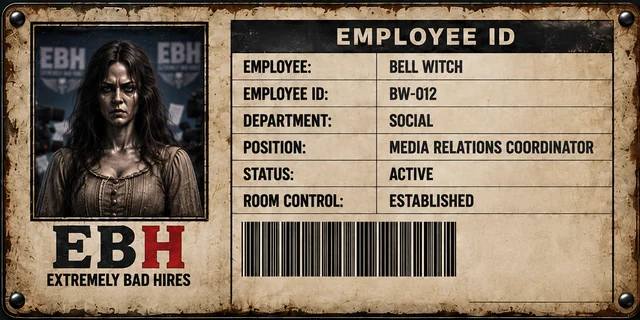 File ID / BW-012
Bell Witch
Media Relations Coordinator
View fileClose file
Bell Witch
Media Relations Coordinator
View fileClose file01 / Background record
History / Lore / What Is It?
The Bell Witch is one of Tennessee’s best-known supernatural legends, centered on the Bell family near Adams in Robertson County. The story places the beginning of the disturbances around 1816 or 1817, when the family reportedly encountered strange animal forms and unexplained noises around their farm. The activity was later said to grow into knocking, scratching, moving bedcovers, pinching, striking, and eventually a disembodied voice. John Bell and his daughter Betsy became the main targets in many versions of the story, while the presence was sometimes described as kind toward Lucy Bell. The entity came to be called “Kate,” and later retellings sometimes connected that name with Kate Batts, though the legend changed considerably as it was passed down. Stories also claim that visitors, including Andrew Jackson, came to investigate. John Bell died in December 1820, and the legend says the spirit later claimed responsibility through a mysterious toxic liquid. The haunting was said to quiet afterward, with later returns becoming part of the tradition. Much of the detailed version known today comes from later nineteenth-century retelling, especially Martin V. Ingram’s 1894 book. Because that account appeared decades after the supposed events, the Bell Witch is best understood as a powerful piece of Tennessee folklore rather than a fully documented historical haunting.
02 / EBH Staffing
EBH Staffing Archive Case File
Bell Witch is filed under Social because every attempt to classify her as a simple haunting has ended with three departments receiving different answers from the same empty conference room. As Media Relations Coordinator, Bell Witch has proven unusually effective at controlling a press event without ever approaching the podium. Her file lists Room Control: Established after a livestream in which reporters’ microphones activated one at a time, chairs moved without assistance, and the building’s PA system answered a question before the spokesperson could. Communications appreciates her ability to imitate voices and redirect a room instantly, but HR has reminded her that pinching hostile reporters, removing bedcovers from visiting journalists, and singing over difficult follow-up questions are not approved media strategies. She has no assigned office, although briefing packets left on an empty chair are routinely returned overnight with corrections, margin notes, and at least one paragraph arguing with Legal. Public Relations maintains that audience engagement improves whenever Bell Witch handles an event. Legal would like them to stop calling that “earned media.”
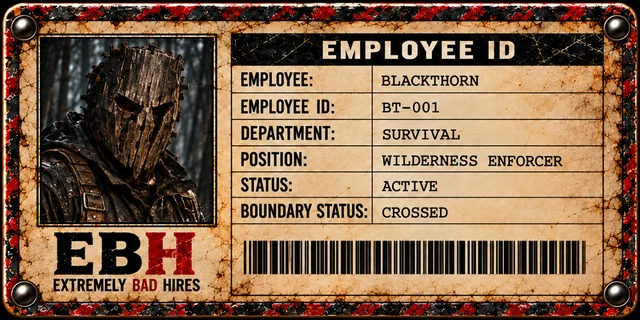 File ID / BT-001
Blackthorn
Wilderness Enforcer
View fileClose file
Blackthorn
Wilderness Enforcer
View fileClose file01 / Background record
History / Lore / What Is It?
Blackthorn is a masked wilderness slasher whose appearances are tied to remote forests, closed trails, logging roads, and stretches of land where somebody has ignored a boundary they were warned not to cross. He is not a harmless guardian, and the people he judges are not always given the chance to leave. Reports describe him as patient, deliberate, and territorial, stalking intruders before deciding that a violation has occurred and then carrying out what he seems to regard as a sentence. Trespassing, poaching, illegal dumping, arson, vandalism, unauthorized timber cutting, animal cruelty, and damage to the land have all been associated with his so-called jurisdiction, but witnesses disagree on how much wrongdoing is actually required to attract his attention. Survivors describe a human-scale figure in dark forestry workwear, his face hidden behind a damaged mask resembling blackened bark and scarred wood, usually carrying a heavy forestry axe. Scenes linked to Blackthorn have included crude citation or sentence tags marked with phrases such as “VIOLATION CONFIRMED” and “APPEAL DENIED,” sometimes left near the bodies of those he has killed. No recognized agency claims him, no ranger station lists him, and no court has ever granted him authority. Blackthorn appears unconcerned with that distinction. The forest has rules. He enforces them permanently.
02 / EBH Staffing
EBH Staffing Archive Case File
Blackthorn was filed under Survival after EBH Staffing decided that “Wilderness Enforcer” was more suitable for the paperwork than “territorial slasher with an axe.” His case file lists Boundary Status: Crossed, which is less a location note than the point at which management recommends updating next of kin. Blackthorn is extremely effective at trail control, illegal-dumping response, perimeter enforcement, and locating people who have wandered somewhere they were specifically told not to go. Unfortunately, his definition of enforcement includes stalking, pursuit, and lethal correction, and he has shown no interest in the difference between a criminal, a reckless hiker, and an employee taking a shortcut through a restricted area. During one backcountry recovery, Rescue requested a guide and Blackthorn returned with the missing party’s equipment, three evidence tags, and no missing party. Management classified the operation as “location confirmed.” Legal objected to the wording. Blackthorn submitted a handwritten response reading “APPEAL DENIED.” His reports remain concise, his trail markings are impossible to misunderstand, and nobody has ever repeated the same violation twice. Rescue requested a guide. Management sent enforcement.
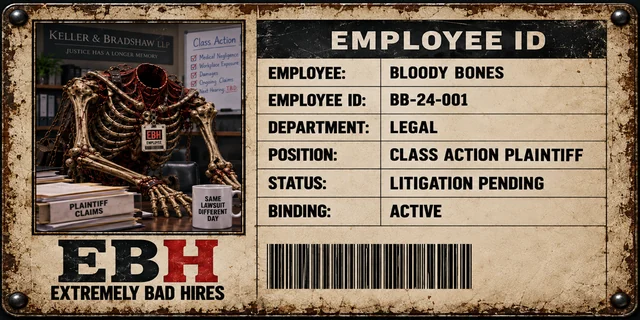 File ID / BB-24-001
Bloody Bones
Class Action Plaintiff
View fileClose file
Bloody Bones
Class Action Plaintiff
View fileClose file01 / Background record
History / Lore / What Is It?
Bloody Bones belongs to a long-lived family of British bogeyman traditions usually called Rawhead and Bloody Bones. Written references go back to the sixteenth century, and in 1693 John Locke complained that adults frightened children with names such as “raw-head and bloody-bones” to keep them obedient. The creature never had one fixed appearance or story. British folklore placed it in dark cupboards, beneath stairs, and near dangerous pits or ponds—exactly the kinds of places children were warned not to explore. Some versions treated Rawhead and Bloody Bones as one terrifying being, while later traditions could separate the names into different figures. The legend also crossed the Atlantic and survived especially strongly in parts of the American South and Appalachia. In some Southern retellings, Rawhead appears as a skinless or severed head while Bloody Bones is imagined as a headless skeleton. Other versions look completely different. That variety is typical of bogeyman folklore: the details shift, but the purpose remains recognizable. Bloody Bones is the thing waiting in the place a child was told not to go, ready to make the warning feel real.
02 / EBH Staffing
EBH Staffing Archive Case File
Bloody Bones was not recruited by Legal. Legal acquired him after discovering his name on the plaintiff list. His current position is Class Action Plaintiff, Status: Litigation Pending, and nobody has been able to determine whether Binding: Active refers to the lawsuit, the dark crimson force holding his skeleton together, or both. Bloody Bones communicates almost entirely by pointing, tapping documents, writing terse notes, and returning forms with increasingly aggressive annotations. Counsel attempted to move the matter into binding arbitration until someone from Records quietly explained that the bones are dead and the Binding is what moves them. That motion was withdrawn. His claims have since expanded to include medical negligence, workplace exposure, damages, procedural misconduct, and several categories Legal insists were not recognized causes of action when the case began. He also continues to occupy the supply closet between hearings despite repeated requests to use the plaintiff waiting area. Settlement discussions remain unsuccessful because every proposed agreement comes back with one skeletal finger tapping the same paragraph. Legal thought it was a case. It was a movement.
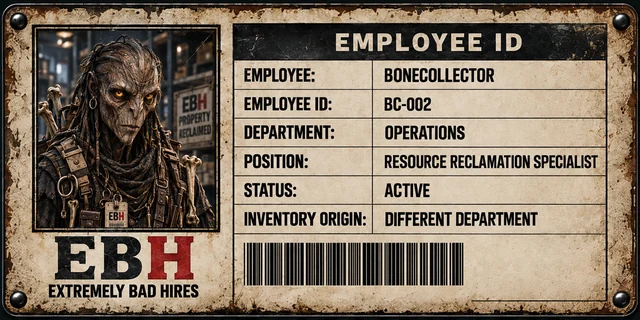 File ID / BC-002
Bonecollector
Resource Reclamation Specialist
View fileClose file
Bonecollector
Resource Reclamation Specialist
View fileClose file01 / Background record
History / Lore / What Is It?
Bonecollector is a gaunt scavenger entity associated with abandoned properties, forgotten storage rooms, disaster cleanups, burial relocations, and places where something has been left behind without anyone willing to claim it. The oldest surviving accounts describe a thin, humanlike figure arriving after everyone else has gone, carrying keys, hooks, tags, scraps of cord, and pieces of bone taken from locations that were supposedly already cleared. Witnesses disagree on whether the bones are trophies, tools, markers, or part of an inventory system only Bonecollector understands. He rarely seems to take objects at random. Items removed from one site have later appeared at another beside remains, records, or personal effects that had been separated from their owner for years. Attempts to recover something from his collection are usually met with silent resistance and the slow production of some other object he apparently considers a fair exchange. This has led to the theory that Bonecollector is not simply hoarding the dead. He may be trying to return unfinished things to wherever he believes they belong. Nobody knows what rules determine ownership, when an object becomes abandoned, or why his definition of recovered property sometimes includes things that were still being used.
02 / EBH Staffing
EBH Staffing Archive Case File
Bonecollector was assigned to Operations after three separate departments accused him of theft and Operations successfully reclassified all three incidents as resource reclamation. As Resource Reclamation Specialist, Bonecollector is extremely efficient at locating missing equipment, undocumented property, unclaimed supplies, and anything left unattended long enough to become, in his judgment, available inventory. His file lists Inventory Origin: Different Department, which Accounting considers less of a custom field than a confession. He has returned lost access keys after six months, recovered equipment from rooms Facilities swore did not exist, and once completed an asset audit by emptying another department's storage cage onto his desk before anyone realized he had a desk. Complaints about missing staplers, radios, specimen containers, office chairs, and one anatomical teaching skeleton are now routed directly to Bonecollector, who usually produces the item after several minutes of offended staring and an exchange request nobody can interpret. Operations insists he saves the company money. Every other department would like Operations to stop calling their property “company-wide resources.”
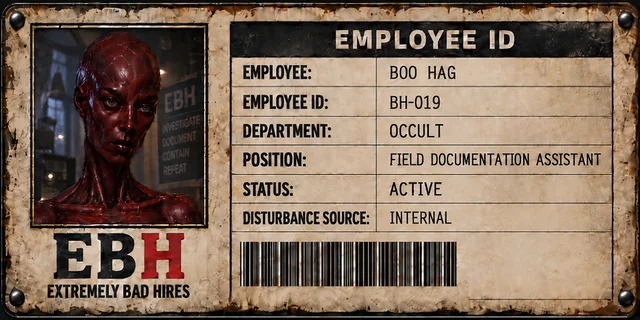 File ID / BH-019
Boo Hag
Field Documentation Assistant
View fileClose file
Boo Hag
Field Documentation Assistant
View fileClose file01 / Background record
History / Lore / What Is It?
The Boo Hag belongs to the living folklore of the Gullah Geechee people of the coastal Southeast, a culture shaped by African traditions preserved and transformed by generations of Black communities in the Carolinas, Georgia, and Florida. Historical descriptions of Gullah hag beliefs tell of a dangerous witch or spirit that leaves its body or skin behind at night, travels unseen, and "rides" a sleeping person, sometimes leaving the victim weak or ill by morning. Modern Boo Hag stories often describe the night form as skinless and raw, able to slip through small openings before pinning a sleeper down and draining strength, breath, or life force. The experience is frequently described through pressure, helplessness, and exhaustion, which gives the tradition an obvious resemblance to what medicine now calls sleep paralysis without reducing the folklore to a medical explanation. Protective practices vary by family, teller, and place; recorded traditions include charms and household measures intended to delay, repel, or expose the hag before daylight. Because Gullah Geechee storytelling is strongly oral and community-based, details change between versions and no single description should be treated as the only authentic one. The enduring image is that of a night-rider who turns sleep, vulnerability, and the safety of home into something uncertain.
02 / EBH Staffing
EBH Staffing Archive Case File
Boo Hag was assigned to Occult as a Field Documentation Assistant because management believed “direct experience with night disturbances” would improve the quality of incident reports. That assumption was correct, although her file now lists Disturbance Source: Internal for reasons nobody in Compliance finds reassuring. Boo Hag is excellent at entering restricted spaces, observing overnight activity, and documenting exactly what happened while the rest of the field team was asleep. Unfortunately, she has also triggered six separate investigations by leaving her outer skin folded beside equipment cases, appearing in photographs where no one remembers seeing her, and submitting witness statements that begin with “I was already in the room.” Team members are instructed not to ask whether a difficult night was “just sleep paralysis” until Boo Hag has confirmed her location. Her reports are detailed, punctual, and frequently include information that should have required access nobody authorized. Occult considers her one of its best observers. HR would prefer that the observer stop being listed as the probable cause.
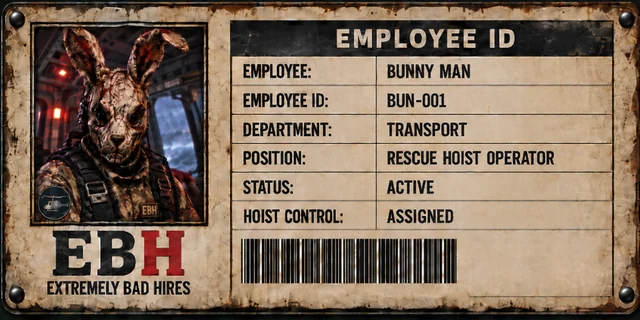 File ID / BUN-001
Bunny Man
Rescue Hoist Operator
View fileClose file
Bunny Man
Rescue Hoist Operator
View fileClose file01 / Background record
History / Lore / What Is It?
The Bunny Man is a Northern Virginia urban legend that grew from a small number of real incidents reported in Fairfax County in October 1970. In the best-documented early encounter, a man wearing what witnesses described as a white rabbit or bunny suit confronted a young couple parked on Guinea Road, accused them of trespassing, and threw a hatchet through the car window. About a week later, a construction security guard reported seeing a similarly dressed man at a nearby house under construction, chopping at part of the structure with an axe and again complaining about trespassers. No one was killed in either documented incident, and the man was never identified. The story quickly spread beyond those reports. Later retellings moved the legend to the Colchester Road overpass near Clifton—now widely known as Bunny Man Bridge—and added escaped asylum inmates, murdered children, hanging rabbit carcasses, bodies suspended from the bridge, and a Halloween curse. Fairfax County historical research has found no evidence that the supposed asylum ever existed or that the murders associated with the bridge actually occurred. The Bunny Man is therefore a classic example of an urban legend built around a small core of documented events that grew darker and more elaborate with each retelling.
02 / EBH Staffing
EBH Staffing Archive Case File
Bunny Man was assigned to Transport after EBH Staffing discovered that a man already famous for appearing where nobody wanted him was surprisingly comfortable working from a rescue helicopter. As Rescue Hoist Operator, Bunny Man handles cable deployment, patient lifts, and extractions with excellent timing and absolutely no bedside manner. His file lists Hoist Control: Assigned because nobody else has volunteered to touch the controls since he began slapping away assisting hands and pointing at the winch like it had personally offended him. Ground crews have repeatedly asked him to stop shouting “TRESPASSING” at stranded hikers while lowering the rescue line, especially when the hikers are on public land. The aircraft crash axe is now secured before every shift for reasons Transport refuses to discuss in writing. Despite the complaints, Bunny Man has never dropped a patient, missed a pickup, or left someone waiting once he has them on the line. Several rescued employees did request reassignment after looking up from a ravine and seeing a blood-spattered rabbit mask descending toward them on a steel cable. Transport considers that a morale issue, not an operational one.
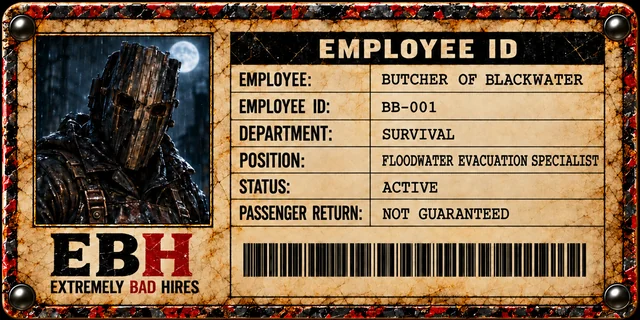 File ID / BB-001
Butcher of Blackwater
Floodwater Evacuation Specialist
View fileClose file
Butcher of Blackwater
Floodwater Evacuation Specialist
View fileClose file01 / Background record
History / Lore / What Is It?
The Butcher of Blackwater is a human-derived slasher tied to the waterways around Blackwater, where roughly a dozen victims have been recovered dismembered from flooded roads, marsh edges, drainage channels, docks, and stretches of shoreline locals had already learned to avoid after dark. Early cases were blamed on boating accidents, flood debris, animals, and the river itself until investigators began finding the same deliberate cuts, missing sections of remains, and signs that someone had moved through the water without leaving a clear approach or escape route. Witnesses describe a broad man in soaked oilskin workwear and a weathered mask marked by a permanent high-water stain, carrying practical tools such as a gaff, boat hook, or heavy cleaver rather than anything theatrical. He is patient, silent, and territorial, often appearing around boats, culverts, boathouses, flooded structures, and isolated stretches of road where rising water has already limited a victim's choices. Reports also claim he can remain submerged far longer than seems reasonable, though nothing about his anatomy suggests anything other than a man. That uncertainty helped create the local stories of a thing living beneath Blackwater. The darker possibility is that there was never a river monster at all. There was only someone who learned how useful the legend could be. The boat came back. The passengers didn't.
02 / EBH Staffing
EBH Staffing Archive Case File
The Butcher of Blackwater was assigned to Survival after EBH Staffing determined that “extensive flood-zone experience” technically counted as a qualification and chose not to ask what happened to everyone else on the boat. As Floodwater Evacuation Specialist, the Butcher of Blackwater is exceptionally good at operating in high water, moving through submerged structures, locating stranded passengers, and returning rescue craft to the staging area. The last item is the only one management can verify consistently. His file lists Passenger Return: Not Guaranteed after three separate evacuations ended with an empty boat, a completed equipment checklist, and fewer people than Dispatch remembered sending with him. He does not speak during briefings, ignores route assignments whenever a canal or drainage cut offers a faster approach, and has repeatedly returned with his clothing soaked while the inside of the boat remained completely dry. Survival insists his completion rate is excellent if the metric is “vehicle recovered.” Legal has asked Survival to stop using that metric. New evacuation forms now include a passenger-count box at departure and return, a change Operations describes as overdue and the Butcher of Blackwater appears to find personally amusing. The boat came back. Management logged the vessel as recovered and opened a separate incident report for the missing passengers.
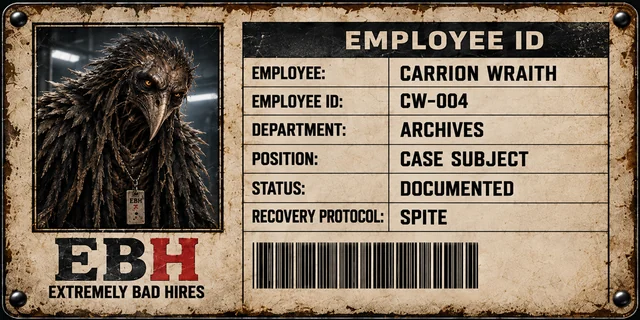 File ID / CW-004
Carrion Wraith
Case Subject
View fileClose file
Carrion Wraith
Case Subject
View fileClose file01 / Background record
History / Lore / What Is It?
The Carrion Wraith is a death-adjacent scavenger apparition most often reported around the injured, the dying, and places where death seems likely but has not yet occurred. It does not behave like a reaper, guide, or executioner. Instead, it appears to sense what may soon become carrion and arrives ahead of schedule. Witnesses describe a gaunt humanoid figure with features suggestive of a carrion bird around the head and neck, a ragged feathered mantle across the shoulders, long thin arms and fingers, and dirty amber eyes fixed on whoever is in the worst condition. It is patient, quiet, and unnervingly composed, sometimes waiting near an accident scene, sickbed, or collapsed victim for long periods without moving. No reliable account shows the Wraith causing the injuries it watches. In several cases, the person it appeared to be waiting for recovered instead, at which point the entity simply stared, withdrew, and vanished. This has led to an uncomfortable theory: the Carrion Wraith does not predict death perfectly. It senses possibility. And sometimes, possibility changes.
02 / EBH Staffing
EBH Staffing Archive Case File
Carrion Wraith remains filed in Archives as a Case Subject because no department has been willing to accept permanent custody of something that appears whenever somebody is already having a very bad day. Its file lists Recovery Protocol: Spite after a documented infirmary incident in which the Wraith arrived beside an incapacitated employee, settled in to wait, and triggered the fastest recovery Medical had recorded all quarter. The employee later stated that dying would have been preferable to “giving that thing the satisfaction.” Similar results followed. Patients who had been unresponsive sat up, injured staff attempted to walk, and one employee removed their own IV after noticing Carrion Wraith watching from the doorway. The Wraith never interferes. It simply waits with the calm confidence of something that believes the paperwork is already finished. Medical has therefore stopped asking Security to remove it unless a patient specifically requests motivation. Archives calls the phenomenon premature scavenging. HR calls it hostile bedside manner. The official Fix report uses a more practical conclusion: Apparently spite is a recognized recovery protocol.
03 / Card appearances
In the deck
- FALSE ALARM — Fix
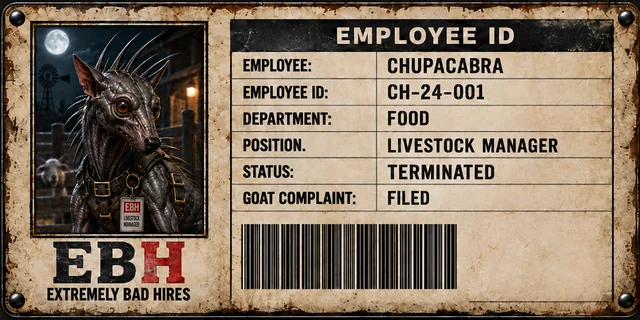 File ID / CH-24-001
Chupacabra
Livestock Manager
View fileClose file
Chupacabra
Livestock Manager
View fileClose file01 / Background record
History / Lore / What Is It?
The chupacabra is a modern cryptid legend that emerged in Puerto Rico in 1995 after livestock deaths were blamed on an unknown predator. Its Spanish name means “goat-sucker,” reflecting stories that goats and other animals had been found with puncture wounds and supposedly drained of blood. Early Puerto Rican descriptions were very different from the animal most often called a chupacabra today. Witnesses described an upright, alienlike creature with large eyes, powerful hind legs, and a row of spines running down its back. As the story spread through Latin America and later into the southern United States, the image changed. By the 2000s, many reported chupacabras—especially in Texas and the Southwest—were described as four-legged, nearly hairless animals resembling strange dogs or coyotes. Carcasses examined from these later reports have repeatedly been identified as known animals, often coyotes or other canids suffering from severe mange, which can dramatically alter their appearance. Claims that livestock victims were completely drained of blood have also not held up well under examination. No scientifically confirmed specimen has established the chupacabra as a distinct blood-feeding species, but the legend remains one of the most recognizable modern cryptid traditions in Puerto Rico, Latin America, and the United States.
02 / EBH Staffing
EBH Staffing Archive Case File
Chupacabra was assigned to Food as Livestock Manager after somebody in Staffing saw “extensive goat experience” on the intake form and stopped reading. The arrangement lasted eleven business days. During that period, herd counts became increasingly difficult to reconcile, night-shift cameras developed unexplained blind spots, and several goats began refusing to enter the same pasture as their new manager. HR initially dismissed the complaints as workplace adjustment issues until one goat learned to head-butt the emergency call button whenever Chupacabra entered the barn. His file now reads Status: Terminated and Goat Complaint: Filed, although Legal has emphasized that termination refers to employment and should not be interpreted as confirmation that anyone successfully removed him from the property. Payroll stopped issuing checks months ago. Feed inventory is still disappearing. The goats have formed what Management is calling an “informal bargaining unit,” and nobody from Food is willing to explain why the complaint form contains hoofprints, three witness signatures, and the phrase “WE WARNED YOU.”
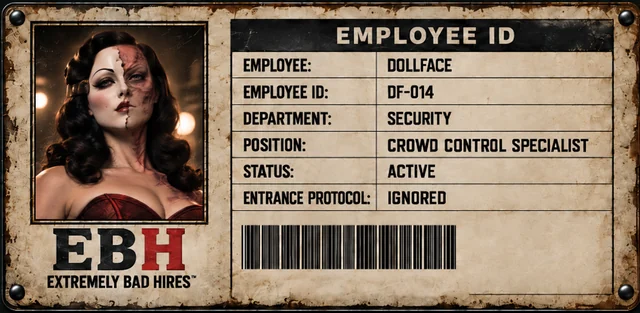 File ID / DF-014
Dollface
Crowd Control Specialist
View fileClose file
Dollface
Crowd Control Specialist
View fileClose file01 / Background record
History / Lore / What Is It?
Before she was known as Dollface, Della Fontaine was one of the rising beauties of 1930s cinema, a performer whose face sold tickets as easily as her name sold headlines. Fan magazines praised her elegance, women copied her style, and studio executives treated her like the kind of star who could be built into an empire. That future ended during the production of a new picture when a catastrophic on-set accident left her severely disfigured. The studio distanced itself, roles vanished, and the same public that once adored her turned cruel. Mockery, pity, and avoidance replaced admiration, and Della eventually began hiding part of the damage behind a porcelain partial mask that preserved a fragment of the face audiences remembered. Somewhere in that collapse, Della Fontaine became Dollface. Sightings since then describe a poised, deliberate killer who fixates on anyone she believes is laughing at her, staring too long, looking away too quickly, or denying her the positive attention she expects. Her signature weapon is a single modified bullwhip ending in a blade, wielded with the precision and showmanship of someone who never stopped thinking in terms of an audience. Dollface does not simply want to be noticed. She expects admiration, and rejection has become something she answers violently.
02 / EBH Staffing
EBH Staffing Archive Case File
Dollface was placed in Security as Crowd Control Specialist after management observed that a hostile room becomes remarkably cooperative when she enters it and asks, very calmly, whether everyone plans to behave. Her file lists Entrance Protocol: Ignored because she has never once used the approved access route, check-in process, or event staffing script. She simply appears where the disturbance is worst and resolves it in a manner Security keeps describing as “effective, if difficult to defend in writing.” Line jumpers, hecklers, aggressive patrons, and anyone making loud remarks about her face tend to become immediate examples for the rest of the crowd. Employees are instructed to greet her politely, acknowledge her without gawking, and avoid phrases like “I thought you’d look different in person.” During one venue incident, Dollface restored order in under two minutes, cleared an aisle, stopped a fight, and left six pages of witness statements that were somehow mostly apologies. She works best in rooms full of people and worst around mirrors, gossip, or anyone withholding the praise she believes is owed to her. Security appreciates the results. HR continues to object to Security referring to her whip as a “customer-facing correction tool.”
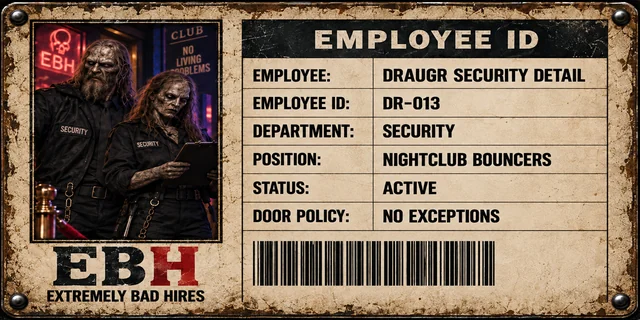 File ID / DR-013
Draugr Security Detail
Nightclub Bouncers
View fileClose file
Draugr Security Detail
Nightclub Bouncers
View fileClose file01 / Background record
History / Lore / What Is It?
In Old Norse and medieval Icelandic saga tradition, a draugr is a corporeal revenant: a dead person whose body remains physically active and capable of troubling the living. Draugar are not simply transparent ghosts. Saga accounts describe them as unusually strong, heavy, difficult to restrain, and sometimes able to leave their burial places to attack people, livestock, or entire households. Some remain closely tied to graves or burial mounds and the property buried with them, while others range farther and become threats to the surrounding community. Grettis saga contains one of the best-known encounters, in which Grettir wrestles the revenant Glámr before cutting off his head and burning the body. Eyrbyggja saga likewise tells of Þórólfr Halt-Foot returning after death, killing people, driving others from their homes, and proving so troublesome that the living repeatedly move, contain, and ultimately destroy his remains. The sagas do not describe every returning dead person in exactly the same way, and different terms are used for different kinds of restless dead. Even so, the draugr is consistently far more physical than the drifting ghost of later popular imagination: when one refuses to stay buried, surviving the encounter may require strength, weapons, decapitation, burning, reburial, or some combination of them.
02 / EBH Staffing
EBH Staffing Archive Case File
Draugr Security Detail was assigned to Security after management realized the club needed bouncers who could remain on their feet through closing time, after closing time, and technically for several centuries after closing time. The pair operates under Door Policy: No Exceptions, a rule they enforce with the solemn dedication of men who have already died once and therefore have very little patience for guest-list arguments. Patrons who announce that they “know the owner” are directed to produce identification. Patrons who announce that they “were here last weekend” are informed that this establishes neither rank nor burial rights. Security reports praise the detail’s resistance to intimidation, refusal to abandon assigned posts, and ability to remove disruptive guests without requesting backup. Complaints focus mainly on excessive staring, the smell of grave earth near the velvet rope, and the fact that neither bouncer appears to understand the phrase “just this once.” One VIP attempted to bypass the line by slipping between them and was returned to the sidewalk so quickly that witnesses disagreed on whether his feet touched the floor. Management considers the incident a successful demonstration of crowd-flow efficiency. The guest list closes at midnight. The dead do not negotiate.
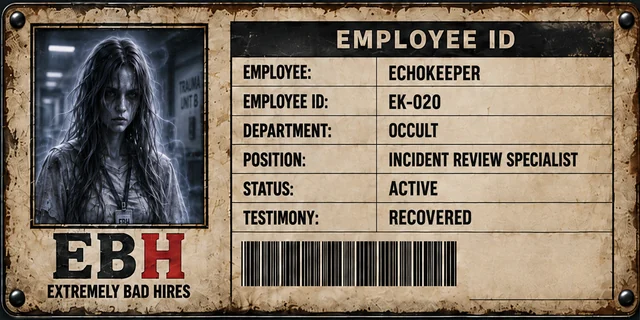 File ID / EK-020
Echokeeper
Incident Review Specialist
View fileClose file
Echokeeper
Incident Review Specialist
View fileClose file01 / Background record
History / Lore / What Is It?
The Echokeeper is a residual entity associated with places where fear, grief, violence, or sudden death seems to leave more behind than physical evidence. Reports describe a pale, humanlike figure appearing after the event is over, often in rooms investigators believed had already gone quiet. The Echokeeper rarely speaks in a voice of its own. Instead, it releases fragments of voices connected to the location: final words, arguments, pleas for help, unfinished sentences, and ordinary conversations that became important only because of what happened afterward. The sounds are not mechanical recordings. They may emerge from different points in a room, overlap one another, or repeat with slight changes in timing, as though the entity is sorting through layers of memory that do not belong to it. Some witnesses believe it absorbs sound at the moment of trauma; others think it gathers whatever a place refuses to forget. Attempts to remove the Echokeeper from an active site usually fail. The figure may disappear, but the voices continue until the scene has been acknowledged, documented, or otherwise resolved. No one has established whether the Echokeeper understands the testimony it preserves. What is clear is that once it has taken hold of a voice, silence is no longer guaranteed.
02 / EBH Staffing
EBH Staffing Archive Case File
Echokeeper was assigned to Occult as Incident Review Specialist after EBH Staffing discovered that interviewing witnesses is much easier when the room itself can be called back for follow-up questions. The file lists Testimony: Recovered, and technically that is true; the problem is that Echokeeper recovers all of it. Incident reviews have included useful last statements, contradictory employee accounts, a supervisor whispering “we are absolutely not putting this in the report,” three minutes of panicked breathing, and an entire lunch order nobody requested. Investigators are instructed not to make sarcastic remarks at active scenes because Echokeeper may replay them during formal review with perfect timing and considerably better acoustics. During Trauma Site Clearance, the entity has proven invaluable at separating a truly empty room from one still holding unresolved voices, although cleanup crews complain that hearing “ROOM CLEARED” followed immediately by somebody from 1987 asking for help is bad for morale. HR has also banned the phrase “off the record” in Echokeeper’s presence. Records loves the accuracy. Legal hates that every careless remark can become part of the record. Echokeeper remembers exactly what was said, even when everyone else wishes it did not.
 File ID / FAE-014
Fae Technical Team
Power Systems Technicians
View fileClose file
Fae Technical Team
Power Systems Technicians
View fileClose file01 / Background record
History / Lore / What Is It?
“Fae” is a modern umbrella label often used for many kinds of supernatural beings found in Irish, Scottish, British, and related European folklore. The older traditions are much more specific and do not describe one single fairy species with a fixed appearance or set of rules. In Irish folklore, the Good People are strongly associated with fairy hills, ancient mounds, ringforts, thorn trees, and other places treated with caution and respect. Stories describe music and dancing, gifts, warnings, abductions, trickery, punishment, and encounters with beings who could be helpful, dangerous, or simply impossible to understand on human terms. Scottish Gaelic tradition likewise speaks of the sìth or sìthichean—the fairy people—who may live in hills or mounds and interact with human communities in ways that range from beneficial to threatening. Traditional descriptions vary widely. Some fairies are small, some human-sized, and some scarcely resemble the delicate winged figures now familiar from children's books and fantasy art. The tiny, flower-winged fairy became especially prominent through later literature and illustration, while older Gaelic traditions often portray the fairy world as more powerful, unpredictable, and closely tied to particular places.
02 / EBH Staffing
EBH Staffing Archive Case File
Fae Technical Team remains assigned to Technical because every electrical problem they touch is eventually solved, even if Facilities cannot explain what happened between “breaker removed” and “building fully powered.” The pair serve as Power Systems Technicians and have repeatedly demonstrated an unsettling ability to identify faults by listening to walls, arguing with transformers, and placing one hand on an energized cabinet while everyone else backs away. Their file lists Safety Distance: Not Maintained after seventeen separate reminders that “high voltage” is not a challenge rating. Lockout/tagout procedures are followed only when a supervisor is physically present, and even then one technician usually disappears behind the panel while the other insists, “It likes us.” During the last outage, they restored power to three floors, disabled two alarms, improved the break-room microwave, and somehow made an unplugged desk lamp blink whenever Accounting says the word “budget.” Technical calls the incident a successful repair. Safety calls it an active investigation. The Fae Technical Team would like both departments to stop standing so far away.
 File ID / CRYP-048
Haunted Armor
Sub-Basement Pump Operator
View fileClose file
Haunted Armor
Sub-Basement Pump Operator
View fileClose file01 / Background record
History / Lore / What Is It?
Haunted Armor is an animated suit of old plate armor with no confirmed occupant and no reliable record of who first wore it. The earliest surviving accounts place the armor in a flooded crypt beneath a long-abandoned estate, where a salvage crew reportedly found it standing upright in waist-deep water with the visor shut. When the suit was opened, there were no bones, clothing, remains, or living person inside. Workers removed it from the site, only to find it back in the crypt before sunrise. Later owners reported the same pattern: the armor moved when unobserved, repositioned itself near stairwells and mechanical rooms, and struck pipes, walls, or valves shortly before leaks, pressure failures, or flooding became visible. Attempts to dismantle the suit have never lasted. Individual pieces stored in separate rooms have later been found reassembled, sometimes while every door between them remained locked. Haunted Armor reacts strongly to rising water, metal fatigue, and failing machinery, but shows little interest in people unless they interfere with whatever it has decided needs protecting. Whether the armor contains a spirit, preserves the habits of a long-dead wearer, or has somehow become the entity itself remains unresolved. Whatever is inside has never been seen. The more troubling possibility is that nothing is.
02 / EBH Staffing
EBH Staffing Archive Case File
Haunted Armor was assigned to Repair after Facilities noticed that every sub-basement flood ended with the pumps running and Haunted Armor standing beside the control panel looking mildly disappointed in everyone. As Sub-Basement Pump Operator, it has several advantages: it does not breathe, does not complain about contaminated water, and can remain waist-deep in a flooded mechanical room long after Safety has ordered everyone else upstairs. Its file lists Occupant: Not Visible because cameras, mirrors, flashlights, and one extremely regrettable inspection scope have all confirmed the same thing—there is nobody inside. Maintenance requests are usually completed without explanation. A failed pump will be found running again, a seized valve will suddenly turn freely, and Haunted Armor will return carrying a wrench that Facilities does not recognize and would very much like back if anyone can determine where it came from. New employees are instructed not to ask who is wearing the armor. The last person who did received no answer, but the helmet slowly turned toward him and every sump pump in the building activated at once. Facilities considers this communication. HR considers it progress. Safety is still disputing how an apparently empty suit of armor passed confined-space certification without producing any evidence that someone is actually inside it.
 File ID / IM-001
Igor Mortis
Rest Status Processor
View fileClose file
Igor Mortis
Rest Status Processor
View fileClose file01 / Background record
History / Lore / What Is It?
No reliable account establishes when Igor Mortis first appeared, although burial records, mourning ledgers, and grave inventories attributed to him have been found in collections far older than any known record of his name. Witnesses describe a gaunt funerary apparition in dark, earth-stained clothing, carrying a heavy ledger and a supply of handwritten tags used to judge whether the dead are ready to be laid to rest. Mortis does not appear to cause death or restore life. Instead, he observes stillness, injury, silence, and other signs he considers sufficient for what he calls Rest Status. The problem is that his standard is not medical. People who were unconscious, sleeping, badly injured, or simply motionless have reportedly awakened to find themselves measured, recorded, or marked for interment. When confronted with unmistakable evidence that a subject is alive, Mortis does not react with surprise so much as irritation at an incorrect entry; he consults the ledger, removes the tag, and amends the record. Accounts disagree on whether he is a revenant, a psychopomp who misunderstands the boundary he is meant to enforce, or something older that treats burial as an administrative certainty rather than a biological one. Whatever his origin, one warning appears repeatedly in stories associated with him: remaining very still in Igor Mortis’s presence is an excellent way to be declared finished before you actually are.
02 / EBH Staffing
EBH Staffing Archive Case File
Igor Mortis works in Operations as Rest Status Processor, a title created after HR rejected “person who decides whether the dead are done yet” as insufficiently professional. His file lists Case Closure: Reopened because Mortis has a documented habit of finalizing Rest Status before the subject has finished using the body in question. Unconscious employees, deep sleepers, and anyone who describes themselves as “dead tired” are strongly advised not to remain motionless near his desk. More than one staff member has awakened wearing a READY FOR INTERMENT tag, at which point Mortis checks the ledger, removes the tag, and records the incident as CLAIMED IN ERROR with the weary annoyance of someone correcting somebody else’s paperwork. Managers have learned to review his determinations before stamping anything FINAL, and Operations now keeps a standing reopening procedure for cases in which the deceased personally objects. Mortis remains unusually efficient, meticulously organized, and almost impossible to distract once he begins processing a file. Records considers him invaluable, although it has formally requested that he stop measuring sleeping employees and returning corrected forms from inside locked filing cabinets.
 File ID / KR-008
Kraken
Heavy Cargo Handler
View fileClose file
Kraken
Heavy Cargo Handler
View fileClose file01 / Background record
History / Lore / What Is It?
The kraken is a legendary sea monster rooted most strongly in Norwegian and broader Scandinavian maritime tradition. Medieval northern accounts describe enormous sea beings whose backs could be mistaken for islands or shoals, while later Norwegian reports tell of a monster rising beneath fishing boats and leaving a dangerous whirlpool as it sank. The kraken became especially prominent in eighteenth-century natural history through Erik Pontoppidan, the Danish-born bishop of Bergen, whose 1752–1753 Natural History of Norway described an immense creature off the Norwegian coast. Carl Linnaeus also classified the kraken as Microcosmus marinus in the first edition of Systema Naturae in 1735 before omitting it from later editions. By the late eighteenth century and afterward, portrayals increasingly favored the giant tentacled form familiar today. Real giant squid likely helped keep such stories believable: enormous squid are genuine deep-sea animals, but they do not verify the ship-destroying monster of legend. The kraken endures where maritime folklore and natural history overlap, shaped by dangerous seas and by the limits of what sailors could see beneath the surface.
02 / EBH Staffing
EBH Staffing Archive Case File
Kraken was assigned to Port Operations after management calculated that eight primary limbs, extraordinary grip strength, and no apparent concern about deep water made the hiring decision "self-explanatory." As Heavy Cargo Handler, Kraken can move containers faster than two dock cranes and has never once requested a forklift certification. Unfortunately, the file lists Dock Space: Denied because the phrase "assigned berth" was interpreted as permission to occupy the entire harbor. Shipping containers routinely arrive stacked correctly but covered in seawater, anchor chains, and the occasional fish nobody can identify. Port crews are instructed to use radio call signs instead of hand signals after Kraken interpreted a supervisor waving both arms as a request for additional cargo. Productivity numbers remain excellent, although Accounting has stopped asking why some manifests include the line "RETURNED TO SEA." During the last scheduling dispute, Kraken lifted the loading office three feet off its foundation and set it back down facing the opposite direction. Operations classified the matter as resolved. Facilities classified it as a structural event. Kraken was denied dock space. Kraken appears to have denied the dock.
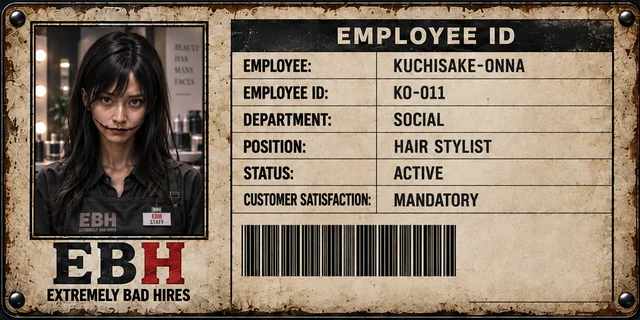 File ID / KO-011
Kuchisake-onna
Hair Stylist
View fileClose file
Kuchisake-onna
Hair Stylist
View fileClose file01 / Background record
History / Lore / What Is It?
Kuchisake-onna, or the “Slit-Mouthed Woman,” is one of Japan’s best-known modern urban legends. The version that became a nationwide phenomenon emerged in Gifu Prefecture in late 1978 and spread across Japan during the first half of 1979, especially among schoolchildren. In the familiar encounter, a masked woman approaches someone—often a child—and asks whether she is beautiful. After a favorable answer, she removes the mask to reveal a mouth slit from the corners toward her ears and asks again. The outcome varies by telling, as do her weapon and the supposed ways to escape; blades, hard candy, pomade, and deliberately ambiguous answers all appear in different versions. The legend changed rapidly as children carried it between schools and media reports amplified it, making variation part of the phenomenon itself. Later retellings have supplied different explanations for her disfigurement, including surgery and other dramatic backstories, but the best-documented history of Kuchisake-onna is the modern rumor cycle that swept Japan in 1979 rather than one securely traceable ancient narrative.
02 / EBH Staffing
EBH Staffing Archive Case File
Kuchisake-onna was assigned to Social as Hair Stylist after Staffing concluded that her fixation on appearance, command of scissors, and ability to make clients answer direct questions counted as relevant experience. Her file lists Customer Satisfaction: Mandatory, which Management keeps presenting as a performance metric even though everyone else understands it as a warning. Consultations frequently begin with Kuchisake-onna asking clients whether she looks beautiful before discussing their hair, and employees have learned that this is not the moment for hesitation, constructive criticism, or the phrase “I liked it better before.” Her cuts are precise, her styling is excellent, and no customer has ever asked to speak with a manager twice. The salon keeps a bowl of hard candy at the front desk for reasons nobody explains to new hires, alongside a laminated card reading: COMPLIMENT FIRST. CLARIFY NEVER. During her last performance review, HR asked whether mandatory satisfaction might be biasing the survey results. Kuchisake-onna smiled, reached for the scissors, and received a perfect score from everyone in the room.
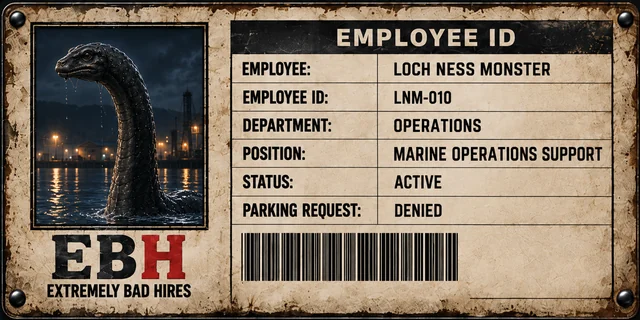 File ID / LNM-010
Loch Ness Monster
Marine Operations Support
View fileClose file
Loch Ness Monster
Marine Operations Support
View fileClose file01 / Background record
History / Lore / What Is It?
The Loch Ness Monster, affectionately known as Nessie, is the legendary creature said to inhabit Loch Ness in the Scottish Highlands. Stories of water creatures in the Great Glen predate modern Nessie lore, though the connection is not always direct. Adomnan's late-seventh-century Life of St. Columba tells of Columba driving off an aquatic beast near the River Ness; later retellings often associate the episode with Nessie, but the original account does not identify the creature as the Loch Ness Monster. The modern legend took off in 1933 after newspaper reports of a large, unusual creature drew widespread attention and a wave of sightings followed. Descriptions have varied ever since, including humps, a long neck, a dark body, or something moving through the water at unusual speed. One of the most famous pieces of supposed evidence was the 1934 "surgeon's photograph," later exposed as a hoax. Searches using boats, sonar, photography, and other technology have continued without producing scientifically confirmed evidence of an unknown giant animal. In 2019, an environmental-DNA study found no evidence supporting plesiosaur, shark, catfish, or sturgeon explanations, while detecting abundant eel DNA. The study did not establish a giant eel or explain every reported sighting. Nessie remains one of the world's best-known unexplained-creature legends - part Scottish tradition, part modern mystery, and an enduring reason to keep watching the water.
02 / EBH Staffing
EBH Staffing Archive Case File
Nessie was assigned to Operations after management determined that an employee already living in deep water could provide Marine Operations Support without requesting housing, mileage reimbursement, or a company boat. The arrangement has been broadly successful, although her file lists Parking Request: Denied after Facilities received an application asking whether "the whole loch" counted as one space. Nessie is particularly useful for underwater inspections, tow-line recovery, locating dropped equipment, and appearing beside vessels whose crews have just said, "There is nothing in this water." Radio communication remains limited, so Operations uses surface markers, sonar pings, and one laminated chart titled PLEASE DO NOT RAM THE DOCK. During the last marine exercise, Nessie returned a lost anchor, two toolboxes, a traffic cone, and a camera missing since 1974. Nobody asked where she found the camera. Her parking request remains denied because the form requires a vehicle make, model, and license plate. Operations has advised Nessie to continue parking wherever she has apparently been parking.
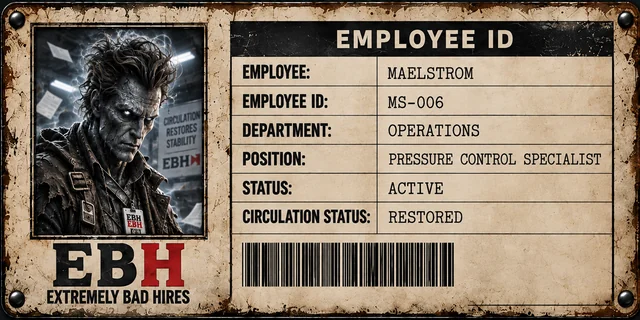 File ID / MS-006
Maelstrom
Pressure Control Specialist
View fileClose file
Maelstrom
Pressure Control Specialist
View fileClose file01 / Background record
History / Lore / What Is It?
Maelstrom is a confined-weather apparition, a barometric pressure-distortion entity most often reported inside sealed or partially enclosed spaces where air, steam, water, or mechanical circulation has been pushed out of balance. The oldest surviving accounts place him in boiler rooms, service tunnels, pump stations, freight corridors, and other industrial interiors shortly before gauges fail or pressure systems rupture. Witnesses describe a storm-gray humanoid figure whose body appears solid but subtly distorted, as though atmospheric force has been compressed into human form. Loose paper, dust, and light debris begin to orbit him; condensation gathers where it should not; vents reverse; doors flex or slam; and local airflow turns in impossible directions. Maelstrom does not simply increase pressure. His presence redistributes it, forcing trapped force to move until a failing system reaches a new equilibrium. The result can prevent ruptures and restore circulation, but the process is rarely gentle. His manifestation is strongest indoors and in confined spaces. In open air, the surrounding pressure has room to disperse, and Maelstrom's form weakens with it. Whether Maelstrom controls pressure or is pressure that learned to wear a human shape remains unresolved.
02 / EBH Staffing
EBH Staffing Archive Case File
Maelstrom was assigned to Operations after Facilities discovered that every catastrophic pressure event stopped being catastrophic approximately thirty seconds after he walked into the room. As Pressure Control Specialist, he can stabilize steam lines, HVAC systems, pumps, sealed tanks, and anything else that has started making the noise technicians describe as “probably fine” right before evacuating. His file lists Circulation Status: Restored, although Operations has learned that restored does not necessarily mean restored in the direction shown on the diagram. Maelstrom dislikes stagnant offices and will unconsciously create airflow if left seated too long, which has resulted in airborne invoices, rotating desk chairs, and one quarterly report completing three laps around the ceiling before Accounting could catch it. He also has a habit of relieving workplace pressure literally; tense meetings have ended with conference-room doors blowing open and every loose document exiting at once. Management considers this an improvement in morale. Facilities considers it a warranty violation. Maelstrom's performance review remains positive because when the gauges hit red, nobody asks where the paperwork went.
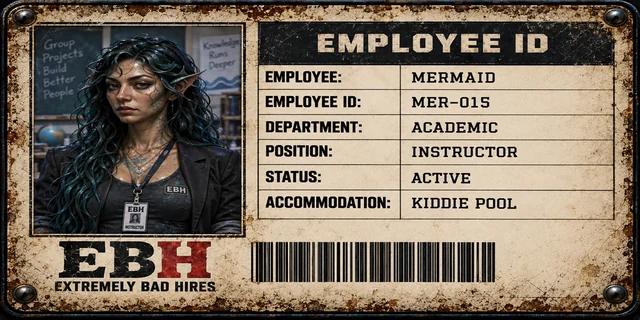 File ID / MER-015
Mermaid
Instructor
View fileClose file
Mermaid
Instructor
View fileClose file01 / Background record
History / Lore / What Is It?
Mermaids are familiar figures in European maritime folklore, but there has never been a single mermaid tradition shared by every culture. In the form most recognizable today, a mermaid has the upper body of a woman and the tail of a fish and may appear as an omen, a danger to sailors, or an alluring figure associated with the sea. Medieval and early modern European art and literature helped establish that image, while older Mediterranean traditions included other hybrid beings that were not originally the same creature. The Greek Sirens are a useful example: ancient depictions generally gave them birdlike bodies rather than fish tails, and the fish-tailed form became associated with them much later. Sailors also reported supposed mermaids in historical travel accounts. In 1493, Christopher Columbus recorded seeing three “mermaids” near Hispaniola; the animals are generally understood today to have been manatees. Manatees and dugongs belong to the mammalian order Sirenia, a name tied to the long association between these animals and siren or mermaid traditions. Humanlike water beings appear in many cultures, but those traditions have their own names, meanings, and histories and should not be collapsed into one universal mermaid tradition. The familiar modern mermaid therefore draws from several strands of maritime storytelling, visual art, literature, and reported sightings rather than from one single source.
02 / EBH Staffing
EBH Staffing Archive Case File
Mermaid was assigned to Academic after Staffing decided that “firsthand maritime experience” was close enough to a teaching credential. As an Instructor, she is popular with students, difficult to schedule above the first floor, and responsible for the only classroom in the department with a posted warning about electrical cords, open beverages, and unexpected tides. Her file lists Accommodation: Kiddie Pool after Facilities denied a full saltwater tank on the grounds that the building was “not zoned for an indoor coastline.” The pool was supposed to be temporary. It now has a cleaning schedule, a faculty parking permit, and its own line item in the Academic budget. Mermaid conducts lectures from the front of the room with her tail resting in the water, periodically splashes students who fall asleep, and refuses to accept essays that describe every dangerous sea woman as a siren. Course evaluations are unusually strong, although several students have complained that “participation credit” should not require retrieving a dropped marker from the far side of the kiddie pool. Mermaid insists this counts as fieldwork. The Academic department has stopped arguing.
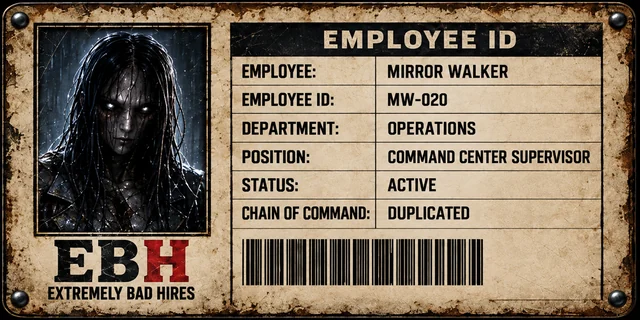 File ID / MW-020
Mirror Walker
Command Center Supervisor
View fileClose file
Mirror Walker
Command Center Supervisor
View fileClose file01 / Background record
History / Lore / What Is It?
Mirror Walker is a singular reflection-bound predatory apparition that travels through valid reflective surfaces, including mirrors, dark windows, polished metal, inactive screens, and still water. Not every surface permits passage; some allow only observation or distortion. Witnesses describe a tall, narrow, humanlike figure with a dark spectral body, long fingers, two pale eyes, and a face that looks almost familiar until the reflection behaves incorrectly. In ordinary space, Mirror Walker moves slowly and deliberately. In reflections, it may change position between glances, appear closer than the room allows, smile while the visible figure remains still, or move first. These changes are not true shapeshifting. They are fear echoes: restrained distortions in expression, posture, distance, or surrounding detail that react to what an observer reveals through fear and attention. No ritual or invocation is required. Breaking a mirror removes one route rather than ending the encounter. The most repeated warning in surviving case notes is simple: the reflection moved first.
02 / EBH Staffing
EBH Staffing Archive Case File
Mirror Walker was assigned to the Operations department after management discovered that inactive screens and reflected surfaces made unusually effective observation posts. Its file lists Chain of Command: Duplicated after one emergency produced six dark monitors showing Mirror Walker in six different positions, each pointing responders in a different direction. Staff are now required to confirm an order from a supervisor visible without relying on a mirror, window, chrome panel, or inactive display. This has made Mirror Walker's own instructions difficult to validate. Turning off a monitor does not help. Covering it helps until someone notices the glass partition beside it. During the last command-center desync, a security review found Mirror Walker in every frame, including feeds from cameras that were turned off. The Operations department considers Mirror Walker highly observant. The Technical department has asked management to stop using the phrase “single point of supervision.” The Facilities team covered the mirrors. The windows remain a problem.
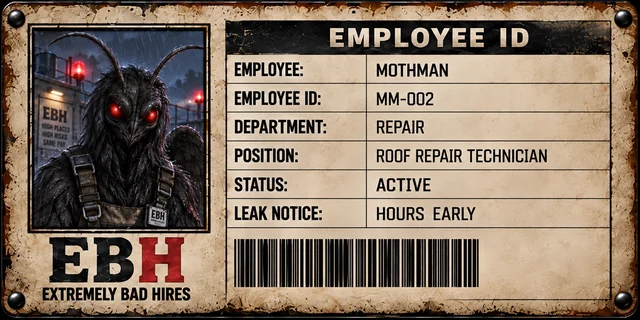 File ID / MM-002
Mothman
Roof Repair Technician
View fileClose file
Mothman
Roof Repair Technician
View fileClose file01 / Background record
History / Lore / What Is It?
Mothman is a modern American cryptid legend centered on Point Pleasant, West Virginia. The best-known wave of reports began on November 15, 1966, when two young couples driving near an abandoned munitions complex commonly known as the TNT area reported seeing a large winged figure with intense red eyes. Their account reached the local newspaper the next day, and additional sightings followed around Point Pleasant over roughly the next year. Descriptions varied, but the large winged silhouette and striking red eyes became defining features of the legend. Skeptical explanations have included misidentified large birds such as sandhill cranes, while paranormal writers connected the sightings with other strange reports from the area. Mothman later became closely linked in popular culture with the Silver Bridge collapse of December 15, 1967, which killed 46 people. John Keel, particularly through The Mothman Prophecies, helped popularize the idea that the creature might have been an omen or warning connected to the disaster. The bridge collapse itself was traced by investigators to a structural failure, so the warning or prophecy interpretation belongs to later paranormal belief and folklore rather than established fact. The combination of eyewitness reports, tragedy, unanswered questions, and decades of retelling has made Mothman one of America's most recognizable cryptid legends and an enduring part of Point Pleasant's identity.
02 / EBH Staffing
EBH Staffing Archive Case File
Mothman was assigned to the Maintenance department after Facilities noticed that his uncanny habit of being nearby shortly before something failed could be useful in preventive maintenance. As Roof Repair Technician, he rarely waits for a leak to become visible. His file lists Leak Notice: Hours Early because he has repeatedly been found standing on a roof, staring at one exact patch of shingles well before the first drip reaches the ceiling. This has improved response times considerably while doing terrible things to employee morale. Staff on upper floors are instructed not to call Emergency Services simply because a pair of reflective red eyes is visible outside a window at 3:00 a.m.; they are supposed to check the maintenance board first. Mothman does not use ladders, considers fall-protection equipment redundant because he can fly, and has never submitted a satisfactory explanation for how he knows which flashing will fail next. During one inspection, he perched above the Accounting department for forty minutes without moving. Everyone evacuated. The problem turned out to be a clogged roof drain. Facilities considers this predictive maintenance. The Accounting department still considers it a prophecy.
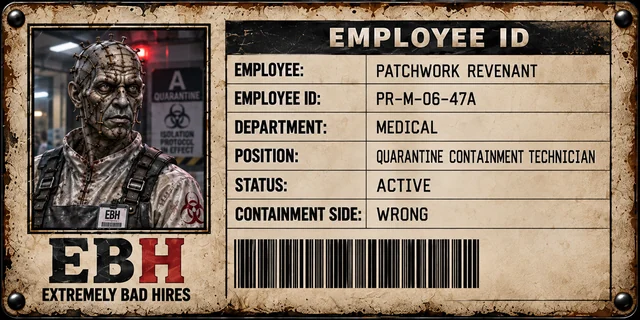 File ID / PR-M-06-47A
Patchwork Revenant
Quarantine Containment Technician
View fileClose file
Patchwork Revenant
Quarantine Containment Technician
View fileClose file01 / Background record
History / Lore / What Is It?
Patchwork Revenant is a constructed undead entity assembled from human tissue that does not appear to belong to a single body. The first reliable case record places it in the medical wing of a shuttered isolation facility after an emergency evacuation, where responders found a stitched figure standing alone beyond a sealed quarantine door. Its body showed deliberate reconstruction: mismatched sections of skin, reinforced seams, heavy sutures, restrained metal hardware at major joins, and scar patterns made at different times by different hands. No matching patient file, donor record, or surgical log has ever been found. Examination suggests portions of the body differ in age and origin, yet the entity moves as one coordinated organism and shows no obvious tissue rejection or active decay. It displays a strong awareness of medical barriers, isolation procedures, and contaminated spaces, often checking seals or repositioning equipment without being instructed. The unanswered question is whether those habits were taught after its construction or survived from one or more of the people whose remains became part of it. Patchwork Revenant rarely speaks and has never identified a maker, a former name, or which side of the quarantine door it believes it belongs on.
02 / EBH Staffing
EBH Staffing Archive Case File
Patchwork Revenant was assigned to the Medical department because he already understood quarantine procedure, wore protective gear without complaint, and could stand beside an isolation door for twelve hours without asking for a break. As Quarantine Containment Technician, he checks seals, moves equipment, escorts exposed personnel, and reacts to contamination alarms faster than most employees can reach the door. His file lists Containment Side: Wrong because every successful lockdown seems to end with Patchwork Revenant on the side everyone else was trying to leave. The Medical department has stopped asking whether this is accidental after he calmly resealed a door behind himself, gave the observation window a thumbs-up, and remained in the hot zone until someone remembered he was still inside. He is exceptionally useful during outbreaks, although new employees are warned not to ask whether he is immune, already infected, or simply too anatomically complicated for the question to be useful. During the last drill, Patchwork Revenant secured the quarantine wing in record time. Unfortunately, he also secured the epidemiologist inside it. The Medical department marked the drill successful. The epidemiologist did not.
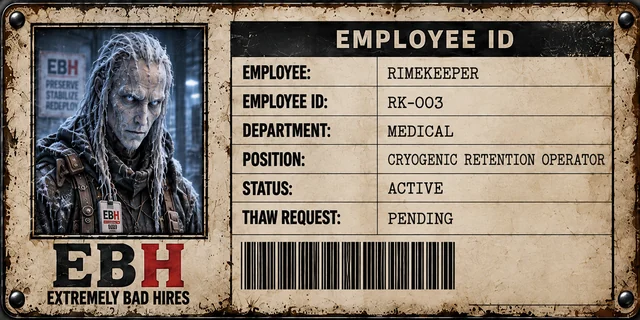 File ID / RK-003
Rimekeeper
Cryogenic Retention Operator
View fileClose file
Rimekeeper
Cryogenic Retention Operator
View fileClose file01 / Background record
History / Lore / What Is It?
Rimekeeper is a cryogenic preservation entity whose behavior revolves around one idea: if something can still be kept, it should not be allowed to change. Reports place him in cold-storage rooms, emergency treatment areas, abandoned refrigeration facilities, and disaster sites where injured people or unstable materials were found unnaturally preserved long after they should have deteriorated. Witnesses describe a tall, lean humanoid with pale, freezer-burned skin, restrained surface rime, cloudy glacial eyes, and long careful hands better suited to handling fragile specimens than fighting. He is quiet, patient, and almost gentle, but his idea of care is absolute. Injury progression, decay, movement, aging, escape, and even recovery can all register to him as forms of unacceptable change. When Rimekeeper intervenes, temperature falls, motion slows, and living subjects can enter a supernatural stasis that prevents their condition from worsening. The danger begins when someone decides the subject is ready to leave. Rimekeeper has been known to resist thawing, relocation, or treatment he interprets as damage to a successful preservation state. He does not freeze people to kill them. He freezes them to keep them. Whether that distinction is comforting depends entirely on how long he intends to keep them.
02 / EBH Staffing
EBH Staffing Archive Case File
Rimekeeper was assigned to the Medical department as Cryogenic Retention Operator after management realized that “stabilized” and “recovering” are not technically the same thing. His file lists Thaw Request: Pending because every release form sent to him comes back marked PRESERVATION STILL EFFECTIVE. He is exceptional at keeping injured employees from getting worse, which is useful right up until the Medical department’s recovery staff asks for the employee back. Rimekeeper has frozen stretchers to the floor, sealed blankets into solid sheets, and once preserved an unconscious technician so thoroughly that the chair had to be included in the transport order. The Medical department summarized the incident as: “The good news is they’re stable. The bad news is they’re frozen to the chair.” He considers thawing an invasive procedure, room temperature an uncontrolled variable, and the phrase “good enough” a personal insult. Staff are instructed not to tell him a patient is “fine now” unless they are prepared to explain why fine should be allowed to become different. The Medical department calls it temporary stasis. Rimekeeper calls it proper storage.
03 / Card appearances
In the deck
- Preservation Hold — Fix
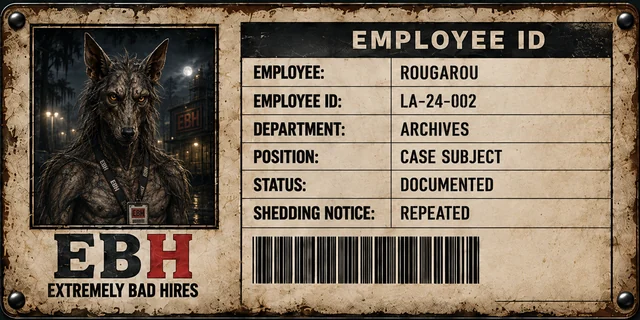 File ID / LA-24-002
Rougarou
Case Subject
View fileClose file
Rougarou
Case Subject
View fileClose file01 / Background record
History / Lore / What Is It?
The rougarou is among South Louisiana’s most recognizable folklore figures. Its name is a Louisiana French reshaping of loup-garou, the French term for werewolf, but Louisiana traditions developed along their own lines and rarely require the creature to resemble a wolf. Stories are especially associated with Cajun and Houma communities in Lafourche and Terrebonne Parishes, where the rougarou may be described as doglike, birdlike, vaguely human, or simply difficult to identify. Many accounts treat the rougarou as a cursed person who assumes a frightening human-animal form at night. In some tellings, release comes only after the rougarou bites or otherwise draws blood from another person, transferring the curse and allowing the previous victim to return to human form. Other versions place a secrecy condition on the encounter: someone who learns the rougarou’s identity must keep it hidden for a prescribed period, commonly a year and a day or 101 days. Rougarou stories have also served as warnings about curfews, obedience, religious obligations, and community rules. Unlike the familiar murderous-werewolf stereotype, Louisiana rougarou traditions are often morally ambiguous. The creature may be frightening or dangerous, but it can also be a victim of the curse it carries, caught between human responsibility and supernatural punishment.
02 / EBH Staffing
EBH Staffing Archive Case File
Rougarou remains filed with the Archives department as a Case Subject after multiple placement attempts ended the same way: everyone else abandoned the shift. The Security department initially described the first incident as a scheduling failure until camera footage showed Rougarou standing motionless beside the employee entrance while six workers clocked out through a fire exit they had previously insisted was alarmed. His file lists Shedding Notice: Repeated because the Maintenance department has now collected enough coarse dark fur from break-room chairs, loading bays, company vehicles, and one sealed HR envelope to fill two evidence bags. Rougarou has also demonstrated an uncomfortable talent for finding missing equipment, unauthorized visitors, and whoever keeps stealing labeled lunches from the refrigerator. He refuses to explain how and becomes visibly offended if anyone uses the word “sniffing.” Staff in the Archives department describe Rougarou as quiet, wary, observant, and generally cooperative as long as nobody corners him, follows him after dark, or asks why his badge sometimes appears on the time clock before he arrives. Management has considered another night assignment. Night staff have considered management’s resignation.
03 / Card appearances
In the deck
- Shift Abandonment — Mayhem
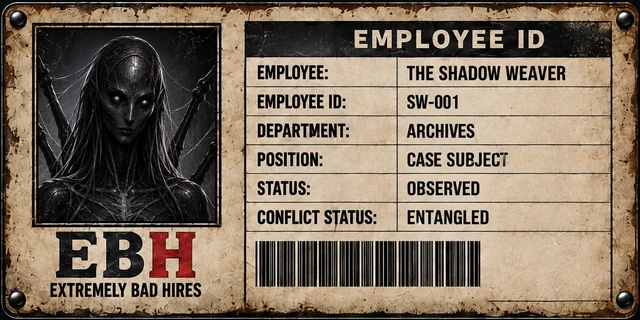 File ID / SW-001
The Shadow Weaver
Case Subject
View fileClose file
The Shadow Weaver
Case Subject
View fileClose file01 / Background record
History / Lore / What Is It?
The Shadow Weaver is a singular, nocturnal entity associated with places where resentment, jealousy, anger, humiliation, hostile grief, or other unresolved conflict has been allowed to linger. Its presence is usually detected before the creature itself is seen. Fine black-violet and dead-silver filaments appear along walls, doorways, ruined structures, or personal belongings, forming web-like connections between people already bound by a grievance. The strands are cold to the touch and may pass through solid surfaces, vanish when cut, or reappear later in nearly the same pattern. Witnesses report fragments of old arguments, movement at the edges of vision, and buried resentment becoming difficult to ignore. The threads do not control minds or create the original conflict; they preserve and intensify what is already there. Full sightings describe a tall, narrow humanoid with two pale reflective eyes, two primary arms, two legs, and four secondary spindle limbs that move through the web without disturbing a strand. No confirmed origin has been established. Whether the Shadow Weaver feeds on conflict, stores it, or merely reveals connections people have already made impossible to escape remains unresolved.
02 / EBH Staffing
EBH Staffing Archive Case File
The Shadow Weaver remains with the Archives department because every department that tried to claim responsibility for it ended up filing a joint grievance against the others. Its file lists Conflict Status: Entangled, created after a routine mediation ended with two employees webbed to the conference table, their supervisor attached to the door, and the HR mediator connected to an unfinished complaint form. The Shadow Weaver does not appear to start arguments so much as reward them with infrastructure. Raised voices produce fresh strands, passive-aggressive emails have been found threaded with filament, and “per my last email” has triggered enough web growth that the Technical department now flags the phrase as a containment risk. Cutting the strands usually works until someone asks who caused the problem, at which point the web starts rebuilding. The Archives department uses thread count as an unofficial warning scale: one strand means tension, three means postpone the meeting, and anything connecting the Legal department to Payroll means evacuate the floor. The Shadow Weaver has never spoken, signed a form, or taken a side. It simply makes sure nobody leaves the conflict until everyone is thoroughly attached to it.
03 / Card appearances
In the deck
- Workplace Entanglement
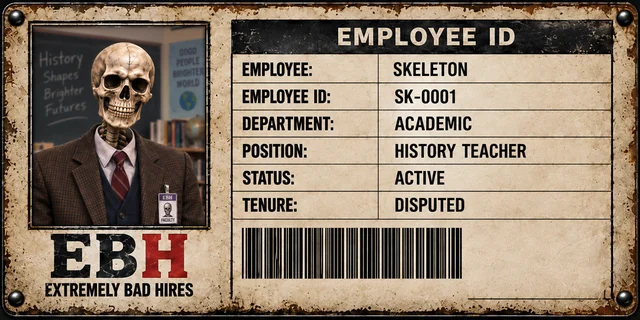 File ID / SK-0001
Skeleton
History Teacher
View fileClose file
Skeleton
History Teacher
View fileClose file01 / Background record
History / Lore / What Is It?
An animated skeleton is not one creature from one fixed folklore tradition. Instead, bones that move, walk, dance, or speak form a recurring supernatural motif that has appeared in stories and art about death, memory, and the boundary between the living and the dead. In late medieval Europe, the Danse Macabre, or Dance of Death, became a powerful reminder that mortality ignored wealth and social rank. Living people from every level of society were shown confronted or accompanied by the dead, and in some early examples the skeletal figures represented dead people rather than a single personification called Death. Related memento mori imagery used skulls, bones, and decaying bodies to remind viewers of the brevity of life and the certainty of death. Later art, literature, theater, and popular supernatural storytelling continued to reuse the moving skeleton in many different ways. Because the motif is so broad, there is no universal set of powers, motives, or rules for an animated skeleton. What remains consistent is the unsettling image itself: the human frame stripped to bone and moving as though death did not quite finish the job.
02 / EBH Staffing
EBH Staffing Archive Case File
Skeleton was placed in the Academic department as a History Teacher after Staffing realized that every lecture eventually turned into a primary-source dispute. His file lists Tenure: Disputed because nobody can determine when he was hired, whether he was ever formally enrolled in the pension plan, or why faculty photographs from several decades contain someone with the same skull but different ties. Students report that his classes are unusually accurate and deeply uncomfortable whenever the syllabus reaches wars, plagues, burial customs, or any event he begins with, “That is not how it happened.” He refuses to use the phrase “dead language,” considers carbon dating “needlessly personal,” and has asked the Academic department to stop displaying replica bones because “some of us are trying to work.” His attendance policy is strict, his lectures are excellent, and no student has successfully argued that ancient history is irrelevant after watching the instructor point to himself as supporting evidence. Administration has tried twice to review his tenure file. Both times Skeleton returned it with corrections to events that happened centuries before the university existed.
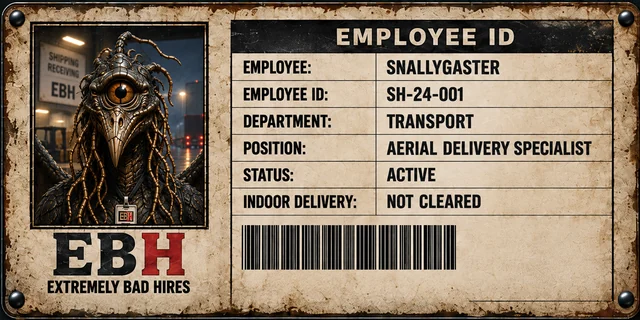 File ID / SH-24-001
Snallygaster
Aerial Delivery Specialist
View fileClose file
Snallygaster
Aerial Delivery Specialist
View fileClose file01 / Background record
History / Lore / What Is It?
The Snallygaster is a winged monster from western Maryland folklore, especially associated with Frederick County and the South Mountain region. Regional retellings commonly connect its name to the German or Pennsylvania German “Schneller Geist,” meaning “quick ghost” or “fast spirit,” and to German-speaking settlers, though the familiar printed monster is most clearly documented in sensational newspaper stories from 1909. Those reports described an enormous flying beast with a long pointed bill, hooked claws, a single central eye, and, in some versions, streamer- or tentacle-like appendages. The stories quickly grew into claims of attacks, disappearances, eggs, and blood-drinking. Several 1909 newspaper stories also explicitly portrayed Black residents as preferred targets, giving the legend a documented racist dimension within Jim Crow-era Maryland. The Snallygaster returned to Maryland papers in later decades, including a 1932 tale claiming that it was drawn to a moonshine still and died after falling into a huge vat of liquor. No physical evidence has established the creature as real, and much of its printed history resembles newspaper hoax and regional tall tale. Even so, the Snallygaster endures as one of Maryland’s most distinctive cryptids: part reptile, part bird, part ghost story, and entirely difficult to keep on the ground.
02 / EBH Staffing
EBH Staffing Archive Case File
Snallygaster was assigned to the Transport department after shipping staff discovered that “air freight” becomes much faster when the freight can simply be grabbed from above. As Aerial Delivery Specialist, it has excellent range, no fuel expense, and a delivery method that the Operations department continues to describe as “direct.” Its file lists Indoor Delivery: Not Cleared after a third-floor package arrived through the window and missed an intern by inches. The intern now checks the delivery schedule before reporting onsite. Snallygaster also refuses loading docks, ignores marked flight paths, and considers any employee standing near a pallet to be part of the lifting instructions. This became a formal concern after an unscheduled airlift carried a forklift operator, half a shrink-wrapped order, and somebody’s lunch across the employee parking lot before anyone located the release paperwork. Recipients are now told to remain under cover until the delivery touches down, stop waving when it approaches, and never point upward while saying “that one.” The Transport department insists the system is efficient. Shipping staff insist the system is kidnapping with a tracking number.
03 / Card appearances
In the deck
- Unscheduled Airlift — Mayhem
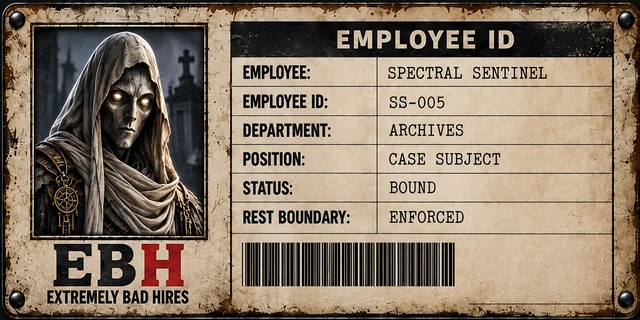 File ID / SS-005
Spectral Sentinel
Case Subject
View fileClose file
Spectral Sentinel
Case Subject
View fileClose file01 / Background record
History / Lore / What Is It?
The Spectral Sentinel is a gravebound guardian apparition associated with cemeteries, mausoleums, mortuaries, morgues, and other places set apart for the dead. Witnesses describe a tall, solemn humanoid wrapped in layered ivory and ash-gray funerary cloth, with pale amber grave-light visible beneath a weathered hood and a ceremonial lantern carried at its side. It bears no visible weapon and rarely behaves aggressively unless a resting place is disturbed. Instead, the Sentinel appears silently at the edge of a grave, chamber, bier, or sealed room and simply refuses to move. Trespass, corpse theft, grave tampering, desecration, and deliberate disrespect can provoke a stronger response: doors refuse to open, paths seem to lengthen, lights dim, and intruders report an overwhelming pressure forcing them back across whatever boundary they crossed. The Spectral Sentinel does not process the dead, collect remains, or hunt the living. Its purpose is narrower: once a person or place has been given rightful rest, the Sentinel treats that rest as a boundary to be protected. Some case notes suggest it is bound to funerary boundaries themselves rather than to any single cemetery or spirit. Others describe it less as a ghost than as a rule given form. Whatever its origin, the warning repeated through its records is consistent: the dead are off the clock, and the Sentinel enforces it.
02 / EBH Staffing
EBH Staffing Archive Case File
Spectral Sentinel remains with the Archives department as a Case Subject because every attempt to assign it a normal post ends with the same problem: it decides where the boundary is, not Staffing. Its file lists Status: Bound and Rest Boundary: Enforced after an incident in a recovery room where a supervisor tried to wake an incapacitated employee early because he “just needed one quick answer.” The Sentinel appeared between the bed and the door, extinguished every light except the EXIT sign, and stood there until the employee’s recovery period was complete. A second manager arrived with a laptop, a coffee, and the phrase “they can work from bed,” then reconsidered all three without being asked. The Medical department now marks protected rest areas with a chalk boundary and leaves the Sentinel alone. Productivity technically drops during recovery periods, but employees return in better condition often enough that HR has stopped arguing with the arrangement. Management calls it obstructive. The Medical department calls it the first mandatory recovery policy anyone has successfully enforced. The Sentinel did not heal them. It just stopped everyone from making it worse.
03 / Card appearances
In the deck
- Mandatory Recovery — Fix
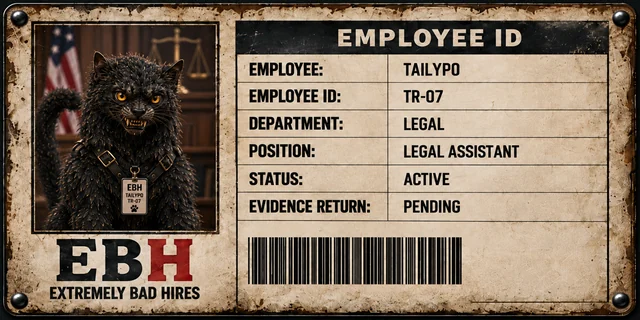 File ID / TR-07
Tailypo
Legal Assistant
View fileClose file
Tailypo
Legal Assistant
View fileClose file01 / Background record
History / Lore / What Is It?
Tailypo is the creature at the center of a traditional American monster tale with deep roots in Appalachian and African American oral storytelling, with related versions also collected elsewhere in the South and in the Ozarks. Because the story traveled largely by word of mouth, there is no single fixed description of the creature or one definitive version of the tale. One early printed account appeared in 1913, when storyteller Richard T. Wyche wrote that he had learned the story from a Black storyteller who had heard it repeatedly in childhood from Black storytellers in Tennessee. In the familiar form, an isolated woodsman or hunter encounters a strange creature with an unusually long tail. The tail is cut off or otherwise taken, and in many versions the man cooks and eats it. After nightfall, the creature returns and repeatedly demands the return of what was taken. Dogs sent after it disappear or are killed, and the tale usually ends with Tailypo reaching the person who still cannot give the missing piece back. Details vary widely: the creature may seem catlike, doglike, or impossible to classify, and related variants sometimes substitute another stolen body part for the tail. A Kentucky version collected in the 1930s was later included in B. A. Botkin's 1944 A Treasury of American Folklore. Tailypo is best understood as an oral monster or jump tale rather than a modern cryptid-sighting tradition, built around repetition, mounting approach, and one grievance that cannot be settled until what was taken is returned.
02 / EBH Staffing
EBH Staffing Archive Case File
Tailypo works in the Legal department because nobody in the company is more committed to the return of missing property. As Legal Assistant, Tailypo tracks exhibits, discovery packets, chain-of-custody forms, and anything stamped RETURN TO OWNER with an intensity that has dramatically improved departmental accountability. Its file lists Evidence Return: Pending after opposing counsel kept an exhibit overnight and received seven voicemails containing several seconds of silence, slow scratching, and a reminder that the item was still outstanding. The exhibit was hand-delivered to the lobby at 3:12 a.m., and counsel has since requested that all future exchanges occur before sunset. Staff in the Legal department are instructed never to say “we lost it,” “we threw it away,” or “you can have it back later” within hearing distance. A junior attorney once misplaced a case folder and spent forty minutes crawling under desks while Tailypo sat in the doorway watching. The folder was eventually found in the attorney's own briefcase. Tailypo still filed a recovery notice. The oldest unresolved claim in its personnel record is stamped TAIL RECOVERY REQUEST REMAINS OPEN. Chain of custody is excellent. Evidence comes back now. Nobody asks how.
03 / Card appearances
In the deck
- Courtroom Catastrophe
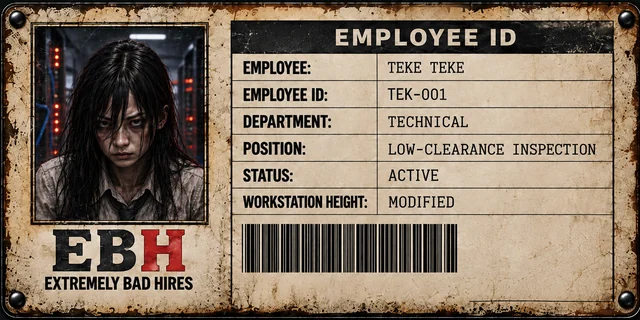 File ID / TEK-001
Teke Teke
Low-Clearance Inspection
View fileClose file
Teke Teke
Low-Clearance Inspection
View fileClose file01 / Background record
History / Lore / What Is It?
Teke Teke is a modern Japanese urban legend and school ghost story rather than an ancient yōkai tradition. The figure most familiar today is the upper half of a girl or young woman moving with startling speed on her hands or elbows; the name is often explained as echoing the rapid, repeated sound of her movement. Earlier published school-ghost-story versions from around 1993–94 were much less fixed. Accounts included upper or lower halves, figures of different ages and genders, and versions with no single railway-death biography. The now-familiar image of a young woman who lost her lower body in a train accident and pursues victims belongs to later popular retellings rather than one verified origin. Publishing and screen media during the 1990s helped establish the Teke Teke name and half-body pursuit image, while later films and internet retellings strengthened the railway narrative. Teke Teke is also frequently blended with Kashima Reiko, a separate but related legless-ghost legend, which helps explain why details about identity, death, weapons, locations, and escape rules differ so widely. The consistent core is simpler: a half-bodied apparition, an approaching rhythmic sound, and a pursuit that closes distance much faster than its form suggests.
02 / EBH Staffing
EBH Staffing Archive Case File
Teke Teke was assigned to the Technical department for Low-Clearance Inspection after Staffing discovered that crawlspaces, under-desk wiring, utility trenches, and floor-level access panels were the first work areas she had ever been perfectly qualified for without modification. That optimism lasted until the Maintenance department submitted the first ergonomic review. Her file now lists Workstation Height: Modified after she requested a lower desk, three desks were shortened, and one monitor was permanently relocated to floor level. Teke Teke completes inspection rounds with excellent speed and rarely misses defects, although employees are instructed not to run when they hear the familiar rhythmic approach behind them; the Security department says this changes the interaction. She also treats anything blocking a low-clearance route as an obstruction to be moved, which became a problem when the obstruction was a rolling chair with an employee still in it. The Technical department considers her reports concise and accurate. The Maintenance department considers the accommodation budget less successful. HR's standing request is that she stop demonstrating proper clearance by passing underneath conference tables during meetings. A note at the bottom of her file remains unchanged: STAIRS REMAIN A HOSTILE WORK ENVIRONMENT.
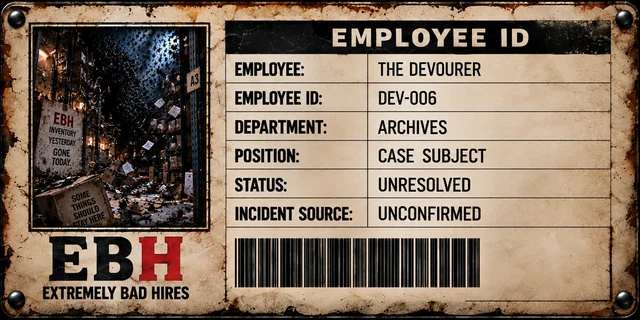 File ID / DEV-006
The Devourer
Case Subject
View fileClose file
The Devourer
Case Subject
View fileClose file01 / Background record
History / Lore / What Is It?
The Devourer is less a creature than a pattern of disappearance. No complete body, face, limb, or silhouette has ever been reliably observed. Instead, investigators recognize it by what stops being there. Incidents begin with small losses: a strip of insulation, a corner of a crate, several pages from a closed file, or a patch of floor ending in an edge too clean to have been cut. The effect then spreads. Matter vanishes without debris, light dims in areas where no bulb has failed, sound becomes strangely muffled, and rooms can develop angles that no longer agree with their own measurements. Swarms of insects are frequently reported during these events, but evidence suggests they are a reaction to the phenomenon rather than part of the entity itself. Witnesses often describe the unsettling impression that something enormous is feeding nearby despite there being nothing visible to feed. Attempts to define its scale have failed because the affected area can range from a single shelf to an entire section of a building. Cameras usually record the loss more clearly than the cause. The most consistent conclusion is also the least comforting: nothing needs to enter a location for The Devourer to arrive. By the time anyone realizes it is present, part of the room is already missing.
02 / EBH Staffing
EBH Staffing Archive Case File
The Devourer remains with the Archives department because assigning a department to something that may be actively consuming the department was judged counterproductive. Its file lists Incident Source: Unconfirmed after the Security department reviewed sixteen hours of footage and found no entry, no exit, no visible subject, and progressively less warehouse. The first formal report came from Inventory, which submitted a zero-loss count at 8:04 A.M. and then discovered that the inventory, the shelving, and most of aisle A3 were gone by 8:11. Accounting rejected the replacement request because the missing assets could not be physically inspected. Accounting's desk was missing the following morning. During the latest Headcount Adjustment incident, management attempted to solve a staffing shortage by adding one more employee to the floor. The Archives department has declined to clarify whether that increased staffing or simply provided additional inventory. Staff are now instructed that the swarm is not The Devourer, the dark patch is not necessarily The Devourer, and any room that suddenly sounds quieter should be left immediately without stopping to collect personal belongings. The current containment strategy is to keep accurate records. The current problem is that the records keep becoming shorter.
03 / Card appearances
In the deck
- Headcount Adjustment — Mayhem
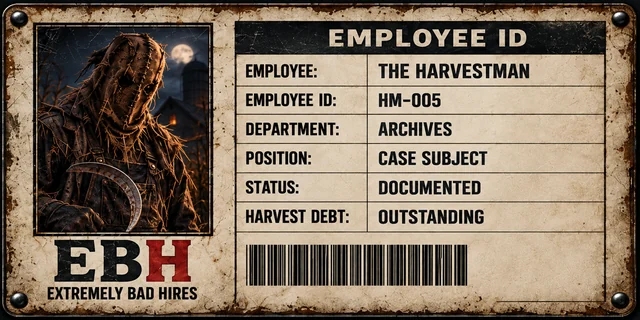 File ID / HM-005
The Harvestman
Case Subject
View fileClose file
The Harvestman
Case Subject
View fileClose file01 / Background record
History / Lore / What Is It?
The Harvestman is a singular rural supernatural figure associated with failed harvests, abandoned farmsteads, unfinished work, and debts promised to be settled after the next crop came in. Reports describe a tall, lean, human-derived figure in weathered field clothes with a damaged grain-sack mask pulled over his head. The mask is usually described with a rough vertical seam, crude repairs, and dark eye openings that reveal little of the face beneath. A single practical sickle is his most consistent tool. He is most often seen after sunset in late summer or autumn, standing motionless between rows, beside fence lines, or at the edge of an already-cut field. Witnesses sometimes report the smell of damp soil and old grain before noticing him, followed by the scrape or tap of metal against dry stalks. The Harvestman does not appear at random. His presence is repeatedly tied to something left unpaid or unfinished: labor never compensated, land stripped and abandoned, crops taken without settlement, or promises deferred until nobody remains to collect them. Tally-like cuts have appeared on fence posts, barn doors, tools, and personal property shortly before disappearances. No verified record explains who he was before becoming The Harvestman, who first incurred the debt, or what payment would finally satisfy it. The warning that survives most often is simpler: once The Harvestman begins counting, he eventually comes to collect.
02 / EBH Staffing
EBH Staffing Archive Case File
The Harvestman remains with the Archives department after Finance rejected every attempt to determine what, exactly, qualifies as Harvest Debt. His file lists Harvest Debt: Outstanding because the balance has appeared on three different ledgers, none of which belong to Accounting, and increases whenever someone requests an itemized statement. The first documented Collection Day incident began when a supervisor found a bundle of straw tied around the break-room time clock with one employee number written on the tag. By lunch, the tagged employee had received twelve automated reminders from a payroll system that does not send reminders. By closing time, The Harvestman was standing in the parking lot with his sickle, waiting with the patience of someone who has already been told the check is in the mail. Management attempted to settle the matter with cash, comp time, produce vouchers, and one gift basket. All were returned unopened. The Archives department now advises staff never to promise repayment “after harvest,” never to sign anything written on seed paper, and never to ask what happens when the debt comes due. The Harvestman has not explained what will settle the balance. He has only marked the next collection date.
03 / Card appearances
In the deck
- Collection Day — Mayhem
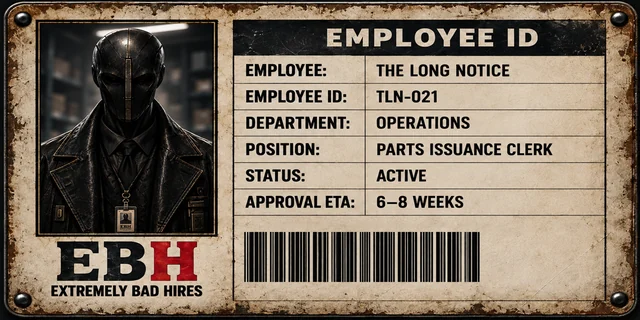 File ID / TLN-021
The Long Notice
Parts Issuance Clerk
View fileClose file
The Long Notice
Parts Issuance Clerk
View fileClose file01 / Background record
History / Lore / What Is It?
The Long Notice is a singular warning-and-enforcement apparition associated with ignored notices, missed deadlines, unresolved violations, and consequences that have been postponed too long. Reports describe an unusually tall, narrow humanoid in dark institutional workwear, with long functional limbs and a recessed facial plane that seems withheld rather than blank. A faint vertical seam or fold is often visible where ordinary features should be. Its presence is usually announced by paperwork nobody remembers posting: overdue warnings, compliance notices, acknowledgment slips, or a final notice placed exactly where the intended recipient cannot avoid seeing it. The Long Notice does not chase. It waits at thresholds, hallways, service counters, and other routes the subject must eventually use. Witnesses who ignore the first appearance sometimes find it closer later without anyone having seen it move. Destroying or discarding the paperwork does not cancel the warning; replacement copies tend to return with additional stamps showing that the matter has been received, escalated, or moved to final notice. No one has established whether The Long Notice creates the consequence or merely arrives when delay has run out. The surviving case files agree on one rule: warnings can be postponed, but they cannot be postponed forever.
02 / EBH Staffing
EBH Staffing Archive Case File
The Long Notice works in the Operations department as Parts Issuance Clerk, where management insists his temperament is 'well suited to process control.' His file lists Approval ETA: 6–8 Weeks, which appears on every request regardless of urgency, inventory level, or whether the requested part is visibly sitting on the shelf behind him. Emergency orders are accepted promptly, stamped carefully, placed in a tray marked EXPEDITED, and then remain there with impressive consistency. Employees who try to bypass the process by borrowing parts directly usually find the item back behind the counter with a rejection slip attached. One technician requested a replacement fuse after a machine stopped working, waited forty-six days for approval, and received the part three weeks after the Maintenance department had already repaired the actual fault. The Operations department considers this proof that the system eventually works. The Maintenance department considers it evidence that 'eventually' is doing too much work in that sentence. The Long Notice has never denied a request outright. He simply ensures that by the time approval arrives, everyone involved understands exactly how long a final notice can feel.
03 / Card appearances
In the deck
- Emergency Parts Requisition
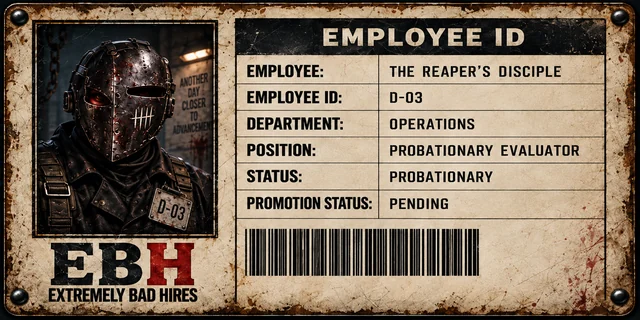 File ID / D-03
The Reaper's Disciple
Probationary Evaluator
View fileClose file
The Reaper's Disciple
Probationary Evaluator
View fileClose file01 / Background record
History / Lore / What Is It?
The Reaper's Disciple is a human-derived figure who presents himself as a probationary apprentice to death. No reliable evidence has established that a true Reaper recruited him, supervises him, or even exists as he claims. What is documented is his obsession with advancement. He tracks performance, studies fatal encounters, and treats violence as part of a certification process only he appears to understand. Witnesses describe practical dark workwear, paired compact reaping hooks, black evaluation cards, and an unfinished asymmetrical metal mask marked with rank cuts and a D-03 designation tab. He is not a personification of Death or an indiscriminate killer. He watches how people respond under pressure, records the result, and compares it against criteria that have never been independently verified. When he kills, the act appears tied to proving competence or advancing his rank rather than carrying out a confirmed cosmic duty. His progression reads INITIATE, DISCIPLE, JOURNEYMAN, and REAPER, but no outside source has confirmed the higher ranks are real. He may be trying to qualify for a position that does not exist.
02 / EBH Staffing
EBH Staffing Archive Case File
The Reaper's Disciple was placed in the Operations department as Probationary Evaluator after management discovered that he had already been conducting performance reviews without being employed, scheduled, or asked. His file lists Promotion Status: Pending because advancement requests arrive with a black evaluation card, an unsigned recommendation form, and at least one employee reconsidering their career goals. He does not raise his voice during evaluations. He records scores nobody can reproduce and waits until the room becomes quiet enough to hear the clock. Attendance, productivity, initiative, and whether the employee “looked prepared when the lights went out” have all appeared as criteria. Satisfactory reviews usually end with a check mark beside the employee's name. Nobody has volunteered to demonstrate what qualifies as unsatisfactory. HR issued a five-point rating scale. The Disciple returned it with a sixth box labeled FINAL and asked whether completing the review counted toward promotion credit. The form was withdrawn. Management still calls him probationary. The Disciple still asks when the next evaluation cycle begins.
03 / Card appearances
In the deck
- Performance Review — Mayhem
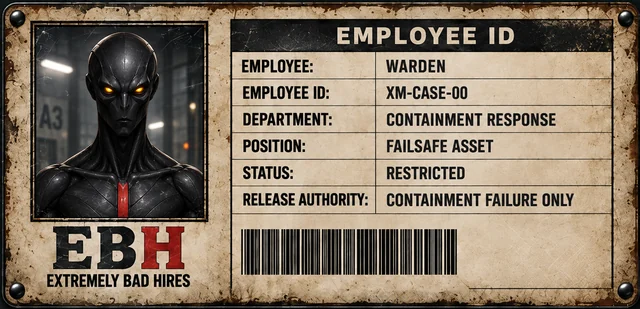 File ID / XM-CASE-00
Warden
Failsafe Asset
View fileClose file
Warden
Failsafe Asset
View fileClose file01 / Background record
History / Lore / What Is It?
Warden is a purpose-built containment entity with no known natural origin. Surviving technical records describe an internal failsafe for situations where ordinary security measures were expected to fail against supernatural or otherwise anomalous subjects. Its standing directive is simple: SUBDUE. RESTRAIN. RETURN. Warden does not negotiate, threaten, or act from anger or fear. Once a containment failure is identified, it advances with methodical precision until the target can no longer resist or escape. Witnesses describe a tall, black, almost seamless humanoid with hard geometric features, amber-orange eyes, no visible mouth, and a red containment mark centered on the sternum. No reliable fatigue response has been recorded, and damage that would stop a living subject appears only to slow it. Official specifications state that lethal force is not authorized. Later files are less reassuring: injury patterns are marked for review, suspected termination events are classified as containment failures, and some reports imply Warden continued after the target was secured. The troubling question is not what Warden was built to control. It is who, or what, was supposed to control Warden.
02 / EBH Staffing
EBH Staffing Archive Case File
Warden remains Restricted under Containment Response because “available for emergencies” and “safe to schedule” are not interchangeable. His file lists Release Authority: Containment Failure Only, and the deployment cabinet still reads BREAK GLASS TO RELEASE WARDEN, which the Legal department insists is not an authorization chain. Once released, Warden follows SUBDUE. RESTRAIN. RETURN with such literalism that Compliance added an unofficial fourth step: PLEASE STOP. During the latest Mandatory Hold, one employee remained physically present but could not count toward staffing because Warden had them secured at a checkpoint while Compliance debated whether “pinned to the floor” qualified as active duty. The report concluded: “present but administratively unavailable.” Warden returned to storage without comment. The Medical department filed three injury reports. The Security department filed none. The post-incident injury pattern remains under review. EBH maintains Warden is stable, controlled, and functioning as designed. Nobody has volunteered to test the word controlled.
03 / Card appearances
In the deck
- Mandatory Hold — Mayhem
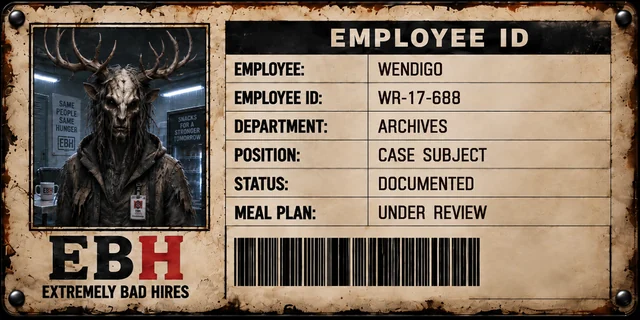 File ID / WR-17-688
Wendigo
Case Subject
View fileClose file
Wendigo
Case Subject
View fileClose file01 / Background record
History / Lore / What Is It?
The wendigo—also spelled windigo and called wiindigoo in Ojibwe—is part of living traditions found in several distinct Indigenous cultures of the northern Great Lakes and subarctic. The stories are not identical across Ojibwe/Anishinaabe, Cree, Innu, and other communities, so no single summary should be treated as universal. Recurring themes in many accounts include winter, starvation, cannibalism, insatiable hunger, greed or excess, and the danger created when appetite overrides responsibility to other people. In some traditions, a human may become a wendigo through cannibalism or destructive greed; in others, the being may be encountered as a dangerous supernatural presence or possessing force. The Ojibwe People's Dictionary defines wiindigoo as a “winter cannibal monster,” underscoring the winter and cannibalism association in Ojibwe usage. Traditional descriptions vary substantially. The now-familiar deer-skull or antlered monster is a later popular-horror image rather than a universal traditional feature. The wendigo is therefore better understood here through themes of insatiable consumption and broken social balance than through one fixed monster anatomy.
02 / EBH Staffing
EBH Staffing Archive Case File
Wendigo remains with the Archives department as a Case Subject because every attempt to assign a food-service role ended with Nutrition Services filing an objection before the meeting started. The file lists Meal Plan: Under Review, a status that has remained unchanged since the first proposal included the phrase “unlimited portions” and caused three departments to withdraw their signatures. Break-room policy now requires lunches to be labeled, secured, and never described aloud as “more than I can finish.” Vending-machine inventory drops sharply whenever Wendigo is documented on-site, although camera footage has yet to establish how anything is being removed. Staff in the Archives department also stopped leaving bowls of candy near the intake desk after every refill disappeared within minutes, despite nobody being seen near it, followed by a handwritten note reading STILL HUNGRY. Management approved a revised meal plan in principle. It currently consists of the words PORTION CONTROL in bold red letters followed by seventeen pages of legal disclaimers.
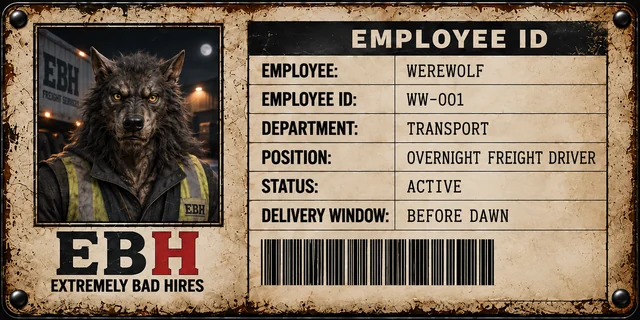 File ID / WW-001
Werewolf
Overnight Freight Driver
View fileClose file
Werewolf
Overnight Freight Driver
View fileClose file01 / Background record
History / Lore / What Is It?
Werewolf legends describe human beings who transform into wolves or wolf-like creatures, a broad tradition with deep roots in European myth and folklore. Classical traditions include Lycaon, whom Zeus transforms into a wolf after an act of horrific impiety. Medieval and early modern accounts offered many explanations for transformation, including curses, divine punishment, sorcery, and enchanted belts or skins. Werewolves were not always willing monsters: some stories describe people trapped in animal form, while others depict dangerous shapeshifters blamed for attacks on livestock or people. Between the fifteenth and seventeenth centuries, parts of Europe held prosecutions for alleged werewolfery, sometimes overlapping with witchcraft trials; surviving records are complicated by torture, superstition, political conflict, and exaggerated accusations. Modern horror later standardized rules older traditions did not share consistently. The full moon became the most famous transformation trigger, and silver became a familiar weapon, but neither was universal in earlier folklore. Across its many forms, the enduring idea is the same: the boundary between human being and predator can become frighteningly thin.
02 / EBH Staffing
EBH Staffing Archive Case File
Werewolf was assigned to the Transport department as Overnight Freight Driver after management decided that exceptional night vision, endurance, and an unwillingness to stop for roadside conversation outweighed several concerns raised by Fleet Services. His file lists Delivery Window: Before Dawn because he insists every overnight route be finished before sunrise; delayed runs usually begin with dispatch receiving the message “RUNNING BEHIND” followed by howling and no further clarification. He is fast, reliable, and unusually effective at discouraging cargo theft, although cab-upholstery replacement has become a standing monthly expense and the company has stopped purchasing steering-wheel covers advertised as “chew resistant.” One weigh-station inspection ended after an officer asked whether the driver was carrying livestock. Werewolf looked toward the trailer, then back at the officer, and the inspection was canceled. Management avoids scheduling livestock runs under a clearly visible full moon unless absolutely necessary. The previous attempt ended with an empty trailer and Werewolf answering the incident report with, “What? I was hungry.” The Transport department still considers his delivery record excellent. The Maintenance department would like him to stop scratching the doors.
03 / Card appearances
In the deck
- Midnight Freight Run
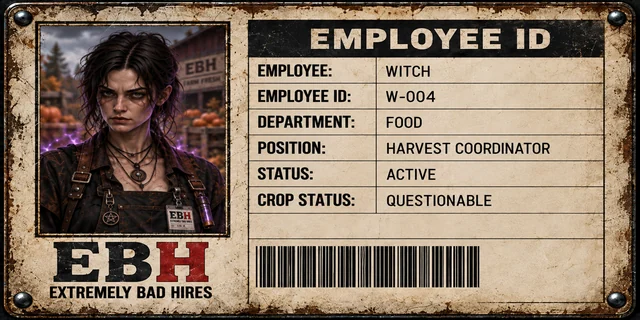 File ID / W-004
Witch
Harvest Coordinator
View fileClose file
Witch
Harvest Coordinator
View fileClose file01 / Background record
History / Lore / What Is It?
“Witch” is a broad term whose meaning has changed across cultures and centuries. In early modern Europe and colonial North America, people accused of witchcraft were often alleged to use harmful magic, curse neighbors, damage crops or livestock, summon spirits, or enter into pacts with the Devil. Those accusations became especially deadly during the European witch hunts, when tens of thousands of people—most of them women—were executed, while the Salem trials of 1692 became one of the best-known American examples of fear, accusation, and injustice. The accused should not be treated as members of one real occult tradition; in Salem, there is no contemporary evidence that the people prosecuted were actually practicing witchcraft. European communities also recognized folk healers, charm-makers, diviners, and cunning folk, but those roles were not automatically the same as the feared demonological “witch.” Familiar visual symbols such as the pointed hat, broomstick, cauldron, and black cat developed through a mixture of older beliefs and later art, literature, theater, Halloween tradition, and popular culture rather than from one universal historical model. Modern Wicca and other contemporary forms of witchcraft are distinct religious or spiritual traditions and should not be retroactively identified with the people accused during historical witch trials.
02 / EBH Staffing
EBH Staffing Archive Case File
Witch was assigned to the Food Service department as Harvest Coordinator after management decided that experience with herbs, seasonal rituals, and unexplained agricultural outcomes counted as relevant field experience. Her file lists Crop Status: Questionable, mostly because every harvest report contains yields that the agriculture team insists are impossible and Witch insists are “within acceptable seasonal variance.” Pumpkins have reached forklift size overnight, corn has appeared in perfect circles nobody planted, and one row of tomatoes now ripens only when complimented. She refuses to discuss pesticide use, preferring jars labeled BLIGHT, BEETLES, and DO NOT SHAKE, while Procurement continues asking why crop-supply requests include candles and black salt. During the last harvest review, management asked how a ten-acre field could contain twelve acres of planted rows without crossing the fence line. Witch replied, “The rows move after sunset,” and changed the subject. The Food Service department considers her results exceptional. Compliance would like the scarecrows to stop changing positions when nobody is looking.
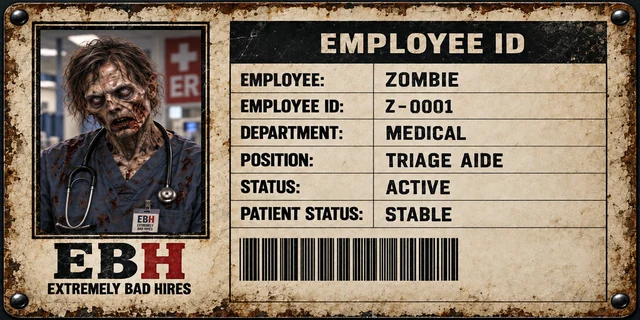 File ID / Z-0001
Zombie
Triage Aide
View fileClose file
Zombie
Triage Aide
View fileClose file01 / Background record
History / Lore / What Is It?
The zombie familiar from modern horror is very different from the zonbi of Haitian tradition. Haitian beliefs are varied and include both corporeal and spirit-related forms, but a recurring theme is the terrifying loss of freedom, identity, and personal will rather than an uncontrollable hunger for flesh. Some accounts describe a person reduced to an obedient state under the control of a bòkò, while others concern a captured or controlled spiritual aspect of a person. These traditions exist within a much larger Haitian cultural and religious world and should not be treated as a simple summary of Vodou, which is a complex religion with its own spirits, ceremonies, communities, and history. Scholars have also connected zonbi traditions to Haiti's history of slavery and forced labor, making loss of autonomy one of the figure's most important meanings. American popular culture transformed the image dramatically. William Seabrook's 1929 The Magic Island helped popularize Haitian zombie stories in the United States, and the 1932 film White Zombie became the first feature-length zombie film. George A. Romero's Night of the Living Dead in 1968, though its creatures were described as ghouls, helped define the flesh-eating reanimated-dead archetype that later became the modern movie zombie. EBH's Zombie uses that later fictional undead tradition and is not presented as a depiction of the Haitian zonbi.
02 / EBH Staffing
EBH Staffing Archive Case File
Zombie was assigned to the Medical department as Triage Aide after management decided that firsthand experience with the difference between dead, apparently dead, and unexpectedly ambulatory counted as clinical exposure. His file lists Patient Status: Stable, which is technically correct because his condition has shown no measurable change since orientation. He performs exceptionally well during mass-casualty intake because blood does not bother him, screaming barely registers, and nobody has ever seen him lose his appetite during a twelve-hour shift. Problems begin when patients ask whether they are going to be okay. Zombie tends to stare at them for several seconds before checking the chart, which the Medical department has been advised is not reassuring. He has also been reminded that “looks alive to me” is not an approved triage category and that biting the cap off a pen is acceptable only if the pen is actually a pen. During one overnight emergency, a physician asked Zombie to keep an eye on a patient until morning. At shift change, the patient was still stable, the chart was complete, and Zombie was standing in exactly the same spot. The Medical department praised his dedication. The Maintenance department asked who was going to clean the drool off the floor.